Specialty Inspection Services - York, PA
Home Humidity & Ventilation Inspection
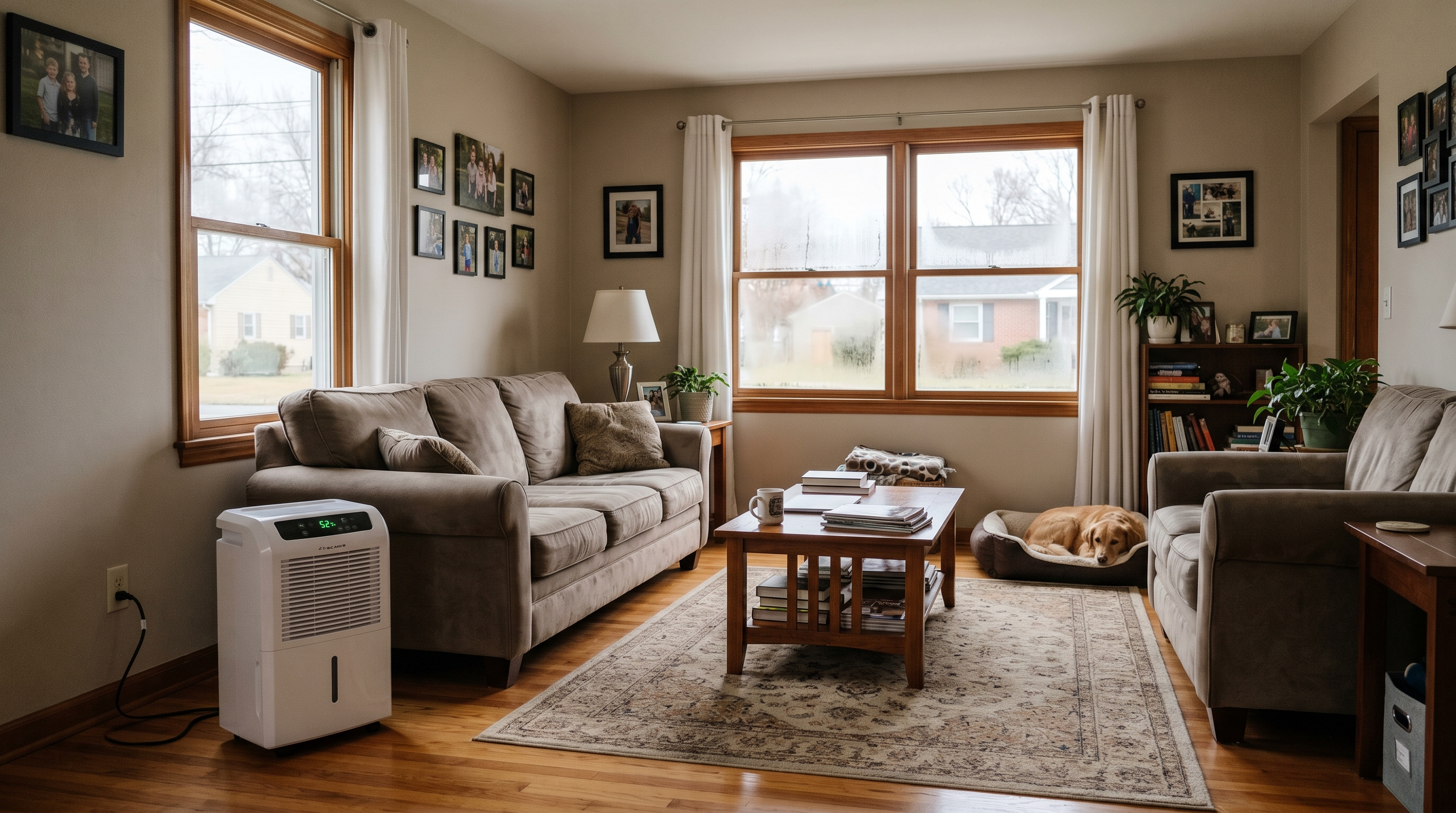
High indoor humidity and inadequate ventilation are the most common causes of recurring mold in York County homes. We identify exactly where moisture is accumulating, why, and what to do about it.
The Root Cause
Humidity Is the Reason Mold Keeps Coming Back
Mold does not grow because a surface is dirty. It grows because a surface is wet - or because the air surrounding it is humid enough to keep it damp. Remove the moisture and mold cannot survive. Leave the moisture in place and mold will return, no matter how many times you clean it.
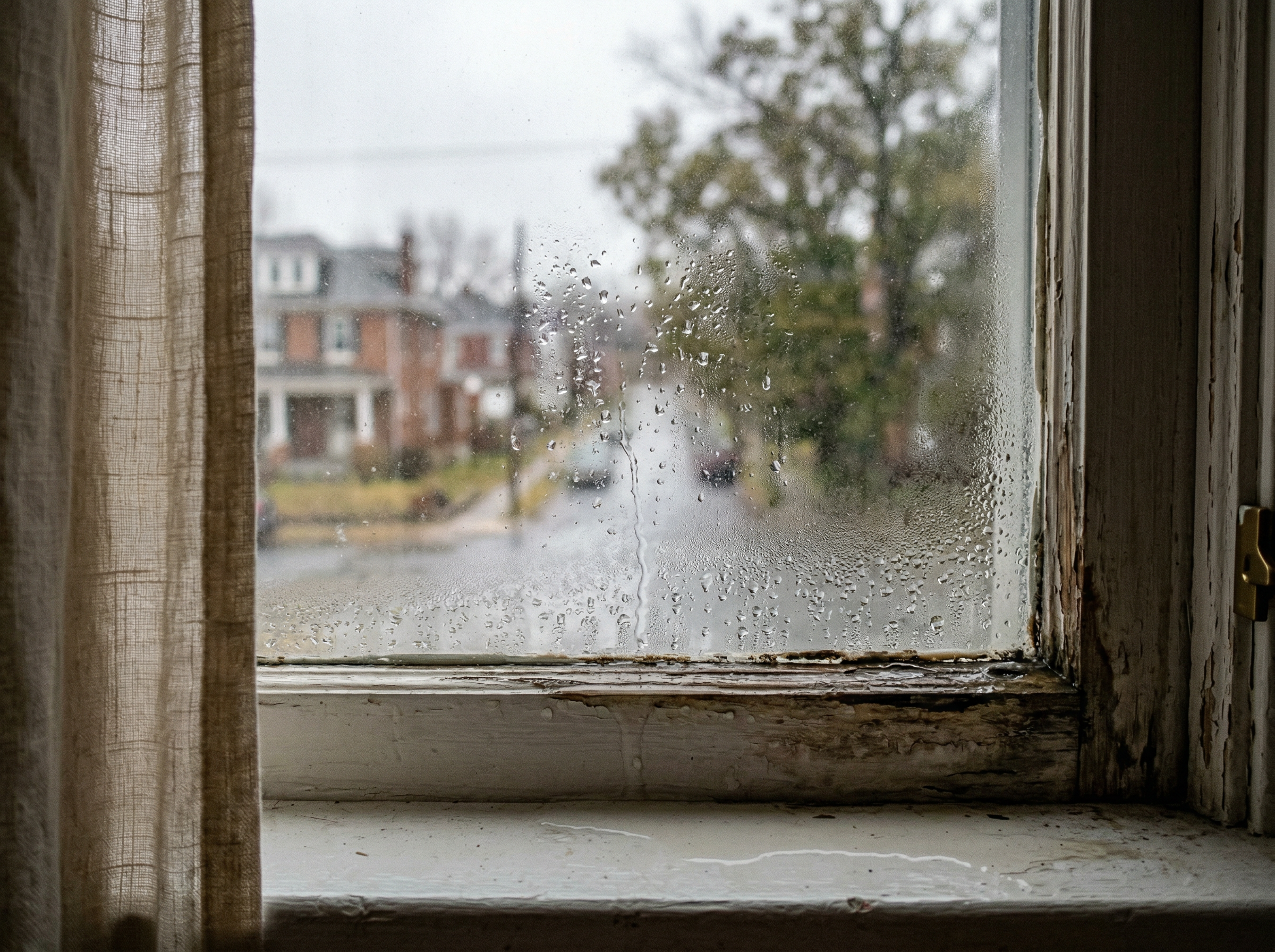
Most mold problems in York County homes are not caused by floods or plumbing leaks. They are caused by chronic elevated humidity from inadequate ventilation, condensation on cool surfaces, and moisture that accumulates slowly and invisibly over months and years. A humidity and ventilation inspection finds the specific conditions that are creating a mold-friendly environment in your home - so they can be corrected, not just cleaned.
The EPA recommends maintaining indoor relative humidity between 30% and 50%. Above 60%, mold growth on organic building materials becomes increasingly likely. In many York County homes during summer, basement and crawl space humidity regularly exceeds 70% or 80% without the homeowner being aware of it.
60%+
relative humidity is the threshold above which mold growth becomes likely on building materials
The Science Behind It
How Humidity and Poor Ventilation Lead to Mold
Understanding the mechanisms that connect indoor humidity to mold growth helps explain why the same mold problem keeps returning - and why fixing the moisture source is the only permanent solution.
Mold Needs Moisture to Survive
Mold spores are present in virtually every home. They only become a problem when they have moisture. When indoor relative humidity stays above 60% consistently, those dormant spores have the moisture they need to germinate and grow on drywall, wood framing, insulation, and other organic building materials.
Condensation Creates Hidden Wet Surfaces
When warm, moist air contacts a cooler surface - an exterior wall, a cold water pipe, a concrete floor - moisture condenses and wets that surface. Over days and weeks, this creates persistently damp conditions on materials that are rarely inspected. Mold can colonize these surfaces completely out of sight.
Poor Ventilation Traps Humidity Indoors
Every shower, cooking session, and breath adds moisture to indoor air. Properly functioning ventilation systems exhaust this moisture to the outside. When exhaust fans are undersized, duct to the wrong location, or simply not used, humidity accumulates in the rooms where it is generated - and spreads through the home.
Seasonal and Regional Humidity Patterns
York County, PA experiences humid summers with outdoor relative humidity regularly exceeding 80%. When humid outdoor air infiltrates a home through gaps in the building envelope, it raises indoor humidity levels throughout the structure - particularly in basements, crawl spaces, and attics where air circulation is limited.
Tight Modern Homes Concentrate Moisture
Energy-efficient homes with improved insulation and air sealing are better at retaining heat - but they are also better at retaining moisture. Without adequate mechanical ventilation to compensate for reduced natural air exchange, indoor humidity levels rise faster and stay elevated longer than in older, draftier homes.
The Dew Point and Surface Moisture
The dew point is the temperature at which moisture in the air condenses on surfaces. In many York County homes, exterior walls, rim joists, and cold-water pipes regularly reach temperatures below the dew point during transitional seasons - creating recurring condensation that feeds mold growth at the same locations year after year.
Warning Signs
Signs Your Home May Have a Humidity or Ventilation Problem
Many humidity and ventilation problems develop slowly and go unnoticed until mold becomes visible. These warning signs indicate that conditions in your home may be approaching or already at the threshold for mold growth:
- Condensation on windows or window frames during cooler months
- Persistent musty or stale odor in any area of the home
- Bathroom mirrors that stay fogged for more than 15 minutes after a shower
- Visible staining or discoloration on bathroom ceilings or walls
- Peeling paint or wallpaper, particularly on exterior walls
- Rust stains on metal fixtures, pipes, or fasteners in the basement
- Efflorescence (white chalky deposits) on basement block or concrete walls
- Wood framing or joists that appear darkened or discolored in the basement or crawl space
- A dehumidifier that runs continuously and fills rapidly
- Allergy or respiratory symptoms that improve when you leave the home
- A home that feels damp or clammy even when the HVAC is running
- Attic insulation that appears compressed, stained, or matted
Important: The absence of visible mold does not mean conditions are acceptable. Mold often grows inside wall cavities, under flooring, and in attic spaces for months before it becomes visible or produces a detectable odor.
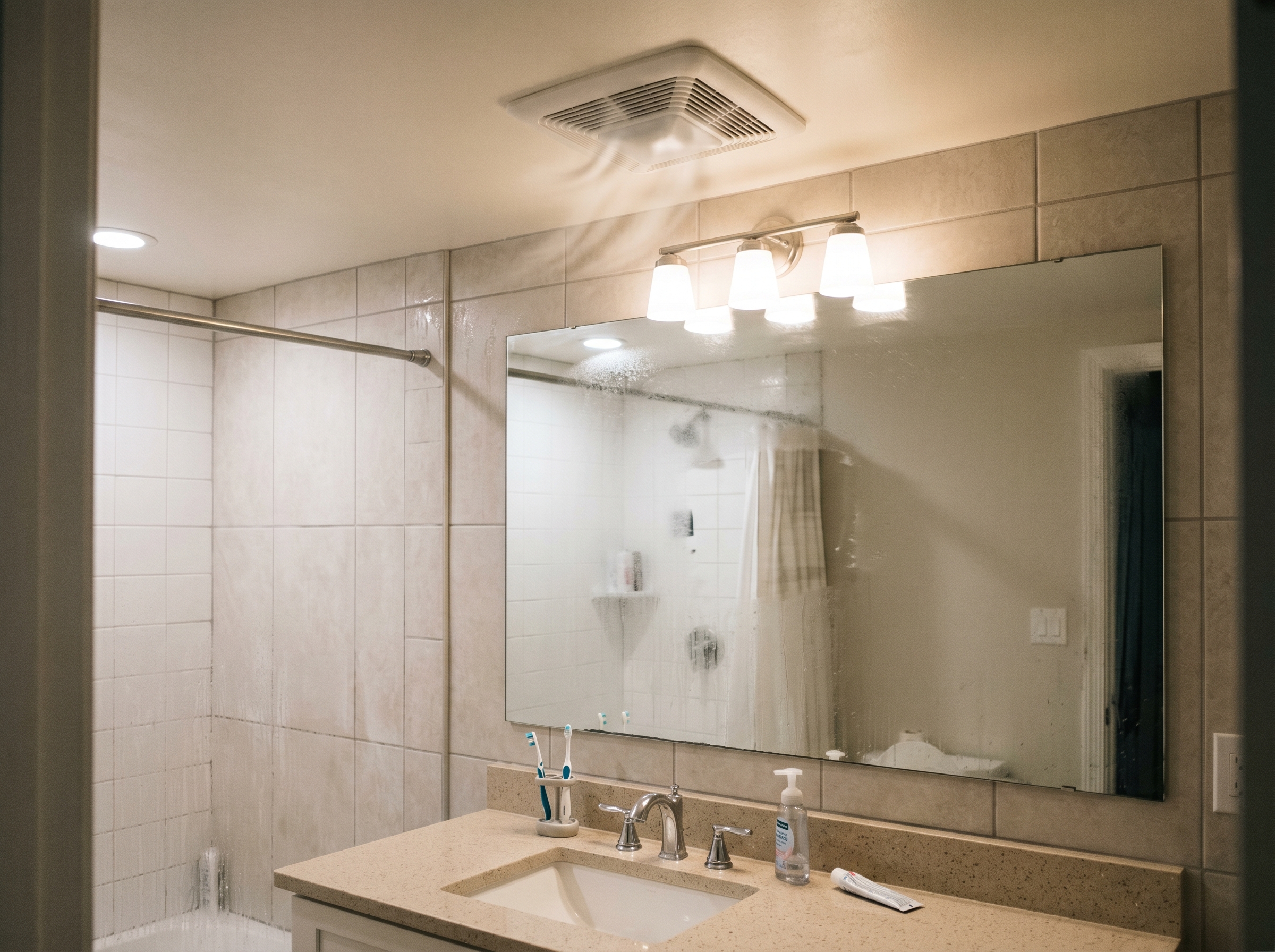
Bathroom exhaust fans are assessed for airflow adequacy, duct routing, and exterior termination - one of the most common ventilation deficiencies found in York County homes.
What We Do
What a Home Humidity & Ventilation Inspection Includes
A systematic, equipment-based assessment of every factor that affects indoor humidity and air quality - from the basement to the attic.
STEP 01
Whole-Home Humidity Mapping
Using calibrated digital hygrometers, we measure relative humidity in every major area of the home - living spaces, bedrooms, bathrooms, kitchen, basement, crawl space, and attic. Readings are mapped to identify which zones are consistently elevated and where moisture is accumulating.
STEP 02
Thermal Imaging for Hidden Condensation
A professional infrared thermal imaging camera detects temperature differentials on walls, ceilings, and floors that indicate condensation-prone surfaces. This reveals hidden moisture accumulation inside wall cavities and behind finished surfaces that no visual inspection can identify.
STEP 03
Ventilation System Assessment
Every exhaust fan in the home is evaluated - bathroom fans, kitchen range hood, and whole-house ventilation systems. We verify that fans are functional, sized appropriately for the space, and venting to the exterior rather than into the attic or wall cavity. Duct routing and termination points are assessed.
STEP 04
Air Exchange and Building Envelope Review
We assess how the home exchanges air with the outside - through intentional ventilation, HVAC systems, and unintentional air infiltration through gaps in the building envelope. Homes that are too tight without adequate mechanical ventilation accumulate moisture rapidly. Homes with excessive infiltration can import outdoor humidity.
STEP 05
Visual Inspection for Mold and Moisture Damage
All accessible areas are systematically inspected for visible mold growth, staining, efflorescence, rust, wood discoloration, and other indicators of chronic moisture exposure. Particular attention is given to areas identified as high-risk by humidity and thermal imaging data.
STEP 06
Written Report with Specific Recommendations
A comprehensive written report is delivered within 1-2 business days. It includes all humidity readings mapped by location, thermal images with annotations, findings from the ventilation assessment, photographs of all observations, and specific actionable recommendations to address identified issues.
Equipment-Based Assessment
We Measure. We Don't Guess.
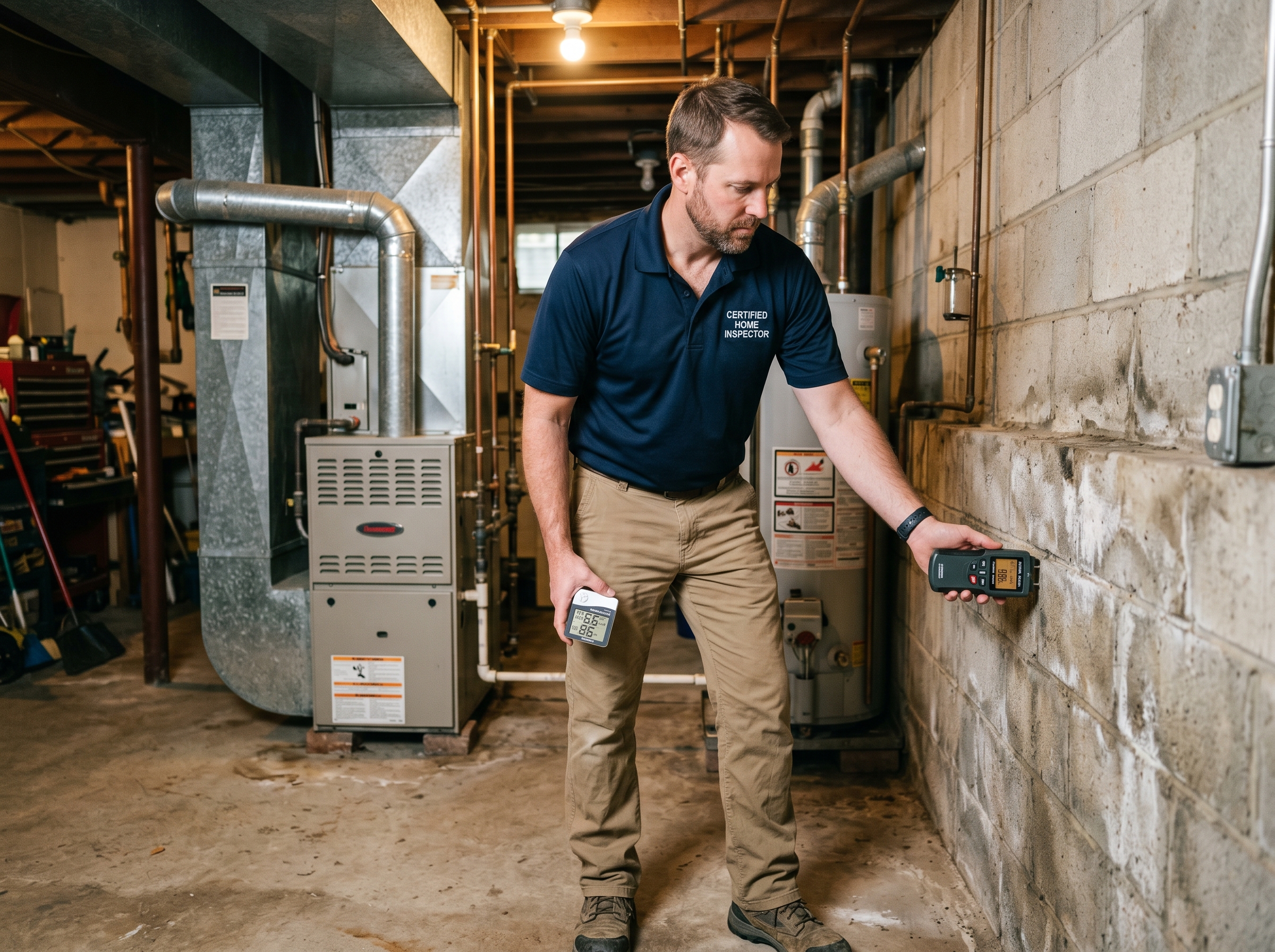
Humidity and ventilation problems are invisible to the naked eye. A visual walk-through cannot tell you whether relative humidity in your basement is 45% or 75%. It cannot show you condensation forming inside a wall cavity or identify a bathroom exhaust fan that is pushing humid air into your attic.
We use calibrated digital hygrometers to measure relative humidity at multiple locations throughout the home, professional thermal imaging cameras to detect condensation-prone surfaces and hidden moisture, and calibrated moisture meters to quantify moisture content in building materials where elevated humidity has been identified. Every finding is documented with specific measurements, not subjective impressions.
- Calibrated digital hygrometers for relative humidity measurement
- Professional-grade thermal imaging camera for condensation detection
- Calibrated moisture meters for building material assessment
- Ventilation airflow evaluation for exhaust fans and HVAC systems
- Comprehensive written report with all measurements and photographs
High-Risk Locations
Where Humidity and Ventilation Problems Most Often Occur
Certain areas of every home are inherently more vulnerable to humidity accumulation and ventilation failures. These are the locations we examine most carefully.
Bathrooms
The highest single-room source of indoor humidity in most homes. Undersized or non-functional exhaust fans allow moisture from showers and baths to saturate ceiling drywall and wall cavities. Grout and caulk failures create secondary moisture pathways into the wall structure.
Kitchens
Cooking generates significant steam and moisture. Range hoods that recirculate rather than exhaust to the exterior, or that lack adequate airflow, allow cooking moisture to accumulate in the kitchen and adjacent spaces. Dishwasher steam and refrigerator condensation add to the load.
Basements
Below-grade spaces are inherently vulnerable to humidity from ground moisture, condensation on cool concrete surfaces, and inadequate air circulation. Many York County basements have humidity levels above 70% during summer months - well above the threshold for mold growth.
Crawl Spaces
Unencapsulated crawl spaces are among the most humidity-compromised areas in residential construction. Ground moisture evaporates into the crawl space air, which then migrates into the living space above. Vented crawl spaces in humid climates often make moisture problems worse, not better.
Attics
Bathroom and kitchen exhaust fans that terminate in the attic rather than through the roof or soffit dump humid air directly into the attic space. Combined with inadequate attic ventilation, this creates conditions for mold growth on roof sheathing and rafters - often undetected for years.
HVAC Systems
Air conditioning systems that are oversized cool the air too quickly without adequately dehumidifying it - a condition called short cycling. Improperly sized or maintained systems, duct leakage, and clogged condensate drains all contribute to elevated indoor humidity and moisture accumulation.
York County's Climate Makes Humidity Management Critical
York County experiences hot, humid summers with outdoor relative humidity regularly exceeding 80% from June through September. During these months, any home without adequate dehumidification and ventilation is at elevated risk for mold development - particularly in basements, crawl spaces, and attics.
The transitional seasons - spring and fall - also present challenges as temperature swings create condensation conditions on cool surfaces. A humidity and ventilation inspection is a valuable tool for understanding how your specific home manages moisture through the full seasonal cycle.
Why Choose Us
Why Choose Mastertech Environmental of York
Independent, certified, and equipped with professional diagnostic tools. We give you accurate findings and specific recommendations - with no interest in selling you anything else.
17+ Years of Experience
Thousands of inspections completed across York County. We understand the specific humidity and ventilation challenges of local housing stock - from older homes with minimal insulation to newer construction with tight building envelopes.
Certified and Independent
Our inspector holds professional certifications in mold inspection and assessment. We are completely independent - we never sell ventilation systems, dehumidifiers, or remediation services. Our only interest is accurate findings.
Professional Diagnostic Equipment
Calibrated digital hygrometers, professional-grade thermal imaging cameras, and calibrated moisture meters provide objective, quantified data. We do not rely on visual assessment alone - we measure.
Actionable Written Reports
Every inspection produces a detailed written report with specific, prioritized recommendations. You know exactly what the problem is, where it is, and what to do about it - with no pressure to buy anything from us.
Air Sampling When Warranted
When humidity and ventilation findings indicate elevated mold risk, air sampling can be added to quantify mold spore concentrations and confirm whether active growth is occurring. All sampling is analyzed by accredited independent laboratories.
Locally Owned and Operated
Based in York, PA. You deal directly with the inspector - not a franchise or call center. Fast scheduling, direct communication, and deep knowledge of local conditions, housing stock, and climate patterns.
Service Coverage
Serving York County, PA and Surrounding Areas
We provide home humidity and ventilation inspections throughout York County, Pennsylvania. If your community is not listed below, reach out - we often cover nearby areas and can coordinate based on your location.
Schedule an InspectionCommon Questions
Home Humidity & Ventilation Inspection FAQs
Answers to the questions York County homeowners ask most often about humidity, ventilation, and mold.
Related Inspection Services
Every service we offer is performed by a certified, independent inspector with no remediation conflict of interest.
Mold Inspection and Testing
Full residential mold inspection with moisture meters, thermal imaging, and accredited lab testing. Comprehensive written report delivered within 1-2 business days.
Learn moreMoisture Intrusion Inspection
Targeted assessment of water entry points and moisture pathways in the building envelope - including foundation, roof, windows, and drainage.
Learn moreThermal Imaging Inspection
Professional infrared camera inspection to detect hidden moisture, insulation gaps, and thermal anomalies inside walls, ceilings, and floors.
Learn moreSchedule Your Inspection
Find out exactly what's driving humidity in your home.
If you have condensation on windows, recurring mold in bathrooms, a musty basement, or simply want to understand the humidity conditions in your home, call or text us at (717) 676-3574 or fill out the form. We schedule quickly, deliver reports within 1-2 business days, and give you completely independent findings with no pressure.
- Certified Mold Inspector - 17+ years of experience and thousands of inspections completed.
- 100% Independent - We never sell dehumidifiers, ventilation systems, or mold remediation.
- Professional Equipment - Calibrated hygrometers, thermal imaging, and moisture meters.
- Locally Based - Serving York, Dallastown, Red Lion, Hanover, West Manchester, and nearby towns.
Call or Text
(717) 676-3574
Tom@mastertechyork.com
Location
York, Pennsylvania 17408
Mon-Fri 9:00am to 5:00pm
Schedule a Humidity & Ventilation Inspection
Call (717) 676-3574 or fill out the form below to get started.