
Moisture Intrusion Inspections in York, PA
Water gets in where you are not looking. A moisture intrusion inspection finds the wet material, measures how far it goes, and names the source it came from — before it turns into mold or a framing repair.
- — 17+ years, 8,000+ inspections
- — Calibrated moisture meters and hygrometer
- — Thermal imaging included, not extra
- — Report in 1-2 business days
Finding the water before it finds your framing
Moisture intrusion is the reason mold exists in a building. Everything else is downstream of it.
Almost every mold problem I am called out to look at is a water problem wearing a different hat. Water comes through a foundation wall, down a rafter, out of a fitting inside a wall cavity, or straight out of the air onto a cold surface — and then the organic material it lands on does what organic material does. Fix the growth without fixing the water and you have bought yourself a repeat performance, usually within a year.
A moisture intrusion inspection is aimed at the water instead of the mold. I read the building visually first, then take moisture content readings off drywall, framing, subfloor and masonry, measure relative humidity through the space, and run an infrared camera across the surfaces where something could be hiding. What comes out of that is a map: which materials are wet, how far the wet area extends, and which mechanism is putting water there.
That last part is the part most inspections skip. Plenty of people will tell you a wall is wet. Telling you it is wet because the grade outside falls toward the house and the downspout discharges four feet from the foundation is a different service, and it is the one that lets you actually spend money on the right repair.
Moisture assessment is part of every inspection I do, but you can book it on its own — and plenty of people should. If you have staining you cannot explain, humidity you cannot control, a smell you cannot locate, or a house you are about to sign for, this is the inspection that answers it.
Staining, a smell, a humidity problem, a recent leak — send me the details and I will tell you what the inspection would cover.
Signs water is getting into your building
These are the things people describe on the phone right before an inspection finds an active moisture source. One of them is enough of a reason to look.
Moisture problems do not stabilize on their own. They get worse on a schedule set by the weather, and the cost of dealing with one scales with how long it ran.
The moisture sources I find in York County buildings
Water enters a building in a limited number of ways. Each one leaves a different pattern, which is what makes the source identifiable.
Foundation and basement seepage
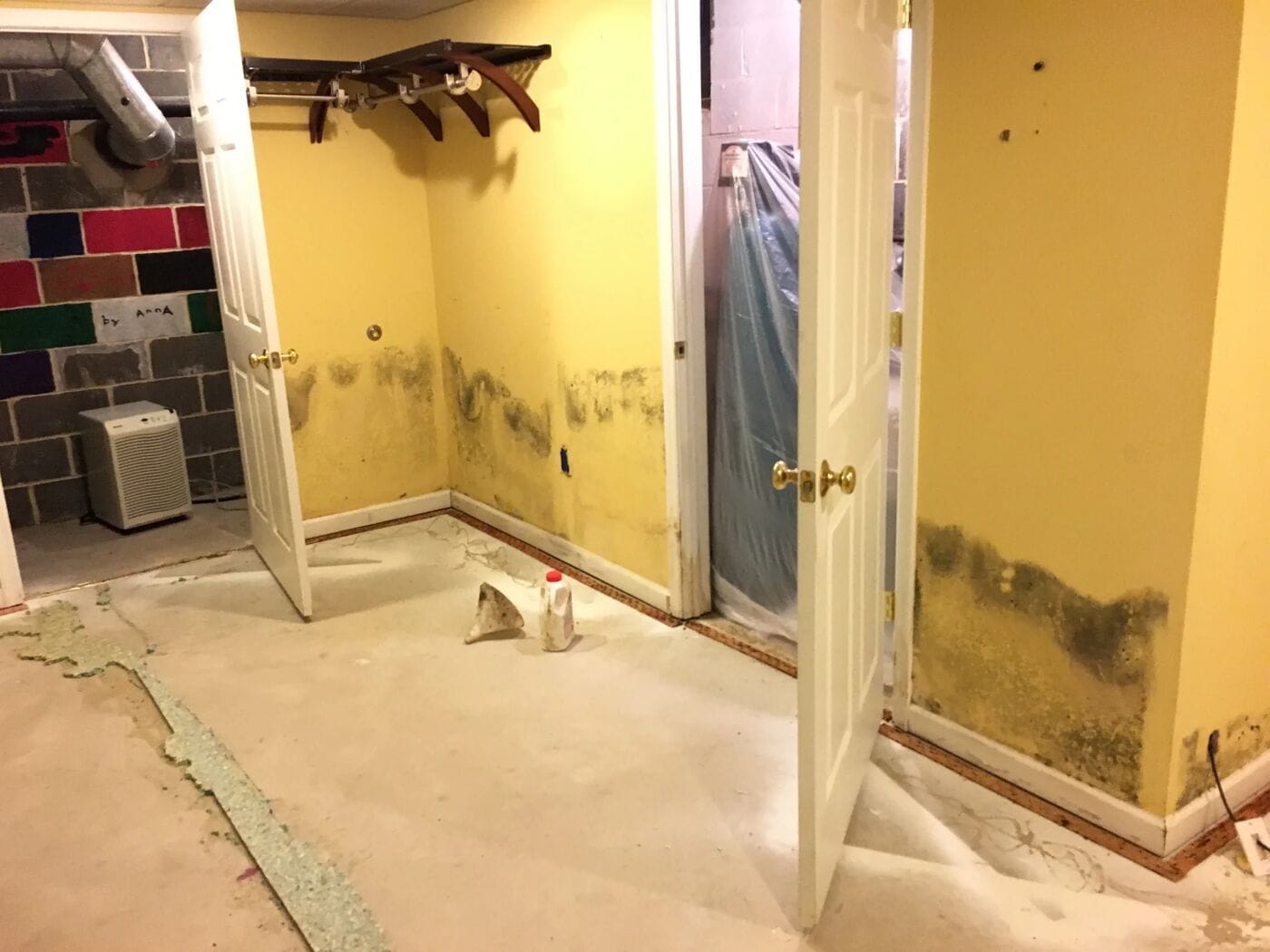
Groundwater pressing against block, stone or poured walls and up through the slab is the most common moisture source in York County. It moves through mortar joints, cold joints and porous block slowly enough that nobody notices until something stored against the wall goes fuzzy or the room starts to smell.
Roof leaks and failed flashing
Lifted shingles, cracked chimney flashing, a skylight curb that was never sealed properly, a gutter that has been overflowing for two seasons. Roof water travels along rafters and through insulation before it shows up on a ceiling, so the stain you can see is rarely above the hole it came through.
Plumbing leaks inside walls
A weeping supply fitting or a drain connection with a hairline crack puts a small amount of water into a cavity every day for years. There is nothing to see and often nothing to hear. These are the leaks I find with a meter on the outside of the wall, usually after somebody calls about a smell they cannot locate.
Condensation and humidity buildup
Warm humid air meeting a cold surface — a block wall, an uninsulated duct, a rim joist, a north-facing closet wall — condenses on it. No leak, no event, no plumbing involved, and enough water over a summer to grow mold on drywall paper and stored cardboard. Underdiagnosed constantly around here.
Window and door flashing failures
Water gets behind a window frame at the head or the sill where flashing was installed badly or has deteriorated, then runs down inside the wall. Common in the older housing stock in York, Dallastown and Red Lion, and capable of rotting a sill plate before a single mark appears on the interior finish.
HVAC condensate and duct leaks
An air handler makes water by design, and it has to go somewhere. Blocked drain pans, failed condensate lines and duct runs sweating in an unconditioned crawl space or attic all put moisture into places nobody inspects. Mechanical rooms and the ceiling directly under an attic air handler are both regular findings.
Numbers, not impressions
Four kinds of data, taken together, are what make a moisture finding defensible.
Material moisture content
Actual percentages off drywall, wood framing, subfloor, sheathing and masonry with calibrated pin and pinless meters. Numbers, by location, in the report — not an adjective.
Relative humidity and dew point
Room by room, plus the problem areas. Hold a space above roughly 60% long enough and mold grows on organic surfaces with no liquid water involved at all.
Surface temperature differentials
Wet material holds and releases heat differently than dry material next to it. That differential is what an infrared camera is actually showing you, and it is how hidden moisture gets located without cutting.
Visible moisture indicators
Efflorescence, rust bleeding at fasteners, tide lines on block, cupped flooring, soft mortar, swollen baseboard, peeling paint. Documented with photos so the pattern is on the record.
About thermal imaging
Infrared is the most oversold tool in this industry and one of the most useful, depending entirely on who is holding it. What an infrared camera shows is surface temperature. Wet material changes temperature at a different rate than the dry material around it, so a wet area inside a wall often reads as a distinct cool pattern on the surface — which is how you find it without cutting a hole.
What infrared does not do is detect water. A cool patch can be a missing batt of insulation, a stud, an air leak around a receptacle, or a shadow that was on the wall ten minutes ago. Anyone who shows you a rainbow-colored image and calls it mold is selling you something.
So I use it as a pointer. It tells me where to put the meter, and the meter tells me whether the material is actually wet. Every thermal anomaly in my reports is paired with a moisture reading and a visible-light photo of the same spot, so you can see what you are looking at. Thermal imaging is included in every mold inspection I do — it is not an add-on line item and it is not a standalone service.
What happens during a moisture intrusion inspection
Same sequence every time, whether it is a 1920s row home in the city or a commercial building in Springettsbury.
Visual assessment
Every accessible area — living space, basement, crawl space, attic, mechanical room. I am reading the building for the pattern first: where the marks are, which direction the water ran, and what the shape of the staining says about the source.
Moisture meter readings
Calibrated pin and pinless meters on drywall, framing, subfloor, masonry and flooring. Elevated readings show up long before a surface feels damp to the hand, and I take control readings off dry material in the same building for comparison.
Thermal imaging scan
Infrared across ceilings, walls and floors to find anomalies behind finished surfaces. It is a pointer, not a verdict — every thermal anomaly gets confirmed with a meter reading before it goes in the report as moisture.
Humidity and ventilation check
Relative humidity through the building, plus a look at whether bathrooms, kitchen, crawl space and attic are actually ventilated. A bath fan venting into attic insulation is a moisture source, and I find one most weeks.
Source identification
Finding wet material is half the job. I trace it back to the mechanism — groundwater, roof, supply line, drain, flashing, condensation, ventilation — because fixing the damage without fixing the source just buys you a repeat.
Written report
Readings by location, thermal images paired with visible-light photos, my assessment of the source, recommendations written as scope a contractor can bid from, and a limitations section on what I could not reach. In your hands in 1-2 business days.
Moisture inspection versus a visual-only look
A visual inspection finds what has already surfaced. That is a useful thing to know and a bad place to stop.
| Capability | Moisture inspection | Visual only |
|---|---|---|
| Finds active moisture behind a finished wall | ||
| Identifies where the water is getting in | ||
| Measures moisture content of building materials | ||
| Quantifies indoor relative humidity | ||
| Documents visible growth and staining | ||
| Leaves you documented readings by location | ||
| Flags mold risk before growth appears | ||
| Non-destructive — no holes, no cuts |
The short version: a visual inspection finds problems that are already visible. A moisture inspection finds the ones that are still hidden, while they are still cheap.
What you actually get out of it
Whether you are protecting a purchase, running a claim, or trying to stop a mold problem before it starts.
You find it before you can see it
By the time moisture damage is obvious to the eye it has usually been developing for months. Catching it while it is still a reading on a meter rather than a colony on a wall is the difference between a repair and a remediation project.
Documented evidence, not opinion
Readings, thermal images and dated photographs hold up in an insurance claim, a real estate negotiation, a contractor dispute or a landlord-tenant argument in a way that somebody's recollection does not.
The source, not just the damage
Plenty of inspections will tell you a wall is wet. The useful part is why. I name the mechanism so the repair gets aimed at the right thing instead of at the symptom.
Mold prevention that actually works
Mold needs water. Remove the water and the problem stops, which is why moisture work is the cheapest mold prevention there is — and why it is cheaper than the remediation it prevents.
Report in 1-2 business days
When you are inside an inspection contingency or an open claim, a report that shows up in three weeks is worth nothing. Tell me the deadline when you call and I will work to it.
Written so you can hand it to someone
Adjusters, attorneys, agents, remediation contractors and waterproofers can all read the same document and understand the same scope. That is the whole point of putting it in writing.
Who books a moisture intrusion inspection
Owners, buyers, landlords and managers dealing with water they can see or water they suspect.
Know what you are buying before you close
A general home inspection is broad and visual by design. It is not a moisture survey, and nobody is taking readings off your future subfloor. What I find before closings, over and over:
- Foundation seepage hidden behind finished basement walls
- Roof-sourced moisture that migrated into a wall cavity
- Supply or drain leaks inside walls near a bathroom or kitchen
- Failed window and door flashing letting water into the wall
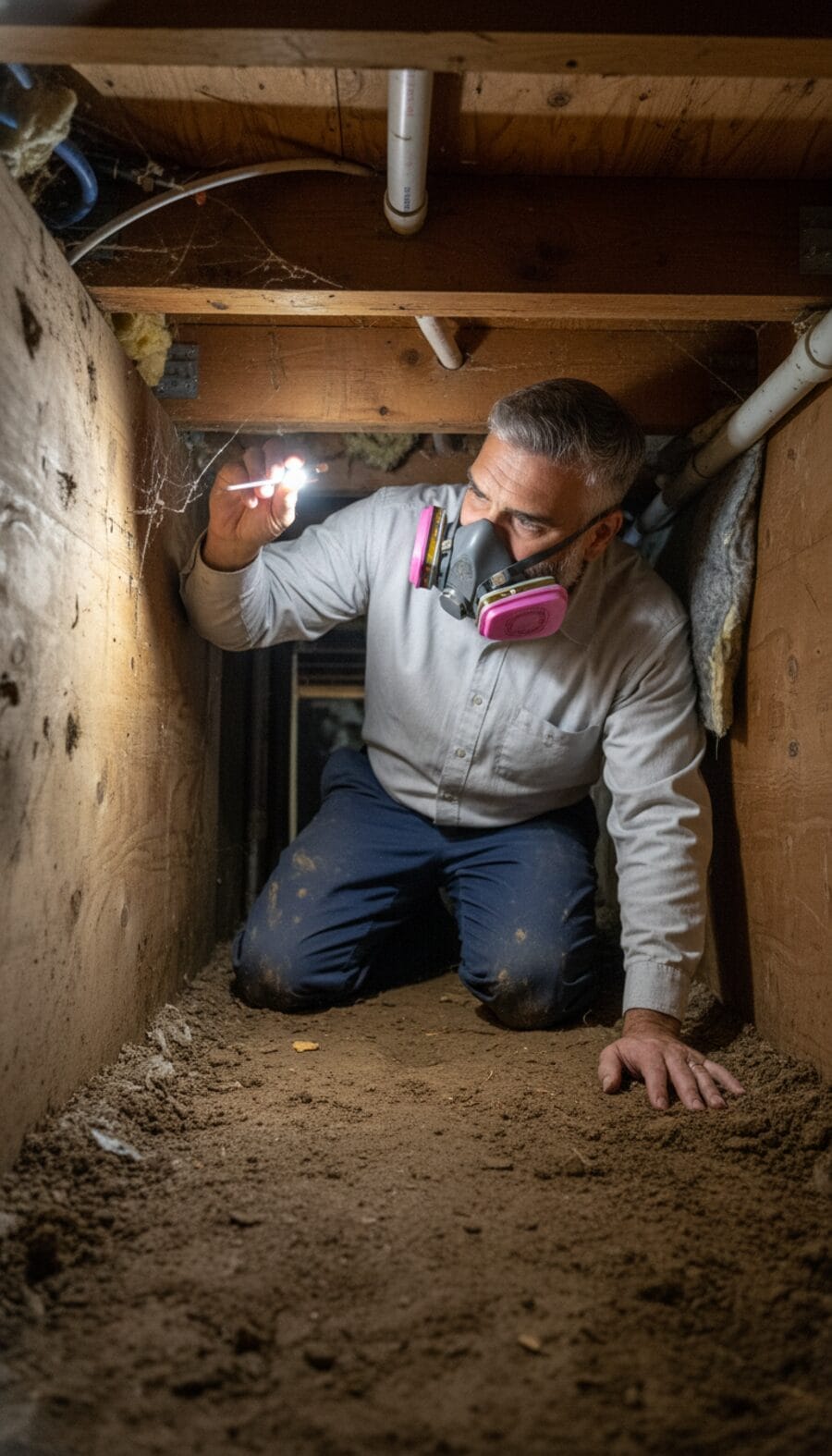
- Chronically wet crawl space framing under a house nobody crawled
Confirm it is dry before mold gets a start
After a flood, a roof leak, a burst pipe or an appliance failure, surface dry is not dry. Moisture migrates into cavities and framing and sits there for weeks. The inspection covers:
- Every wall, floor and ceiling the water actually reached
- Whether the drying that was done was genuinely effective
- Conditions documented for the claim while they are still there
- Secondary migration into rooms nobody thought were involved
- Confirmation the place is dry before any mold testing is done
Why hire me for moisture work
Accurate moisture findings take the right instruments, the training to read them, and no financial interest in the answer.
17+ years and 8,000+ inspections
Moisture in every form it takes in this county — slow foundation seepage, hidden supply leaks, condensation on cold block, storm water in a wall cavity. Pattern recognition is most of this work and it only comes from volume.
Instruments, not gadgets
Calibrated pin and pinless meters, a thermo-hygrometer and a professional infrared camera. Consumer moisture pens and phone-clip thermal attachments produce numbers nobody should be making decisions on.
Certified mold inspector reading the data
A moisture number only means something if you know what it implies for growth. I have been certified through the PMII since 2010 and I teach this work to other inspectors, so the interpretation is the part you are actually paying for.
Reports you can use
Readings by location, thermal images next to the matching photo, plain-English findings, scope-ready recommendations, honest limitations. Download the sample before you hire me and compare it to whatever else you have been handed.
Local, and one person
Based in York, PA. You talk to me on the phone, I do the inspection, I write the report. No call center, no franchise dispatcher, no subcontractor you have never met showing up in the driveway.
Nothing to sell you afterwards
I do not do waterproofing, drying, remediation or repairs, and I take no referral fees from the people who do. There is no version of these findings that makes me more money, which is the only reason to trust them.
- $450 residential, $785 commercial
- 4 accredited lab samples included when sampling is warranted
- Thermal imaging and moisture readings in every inspection
- No remediation, no waterproofing, no referral fees
Indoor Air Quality Testing Beyond the Moisture Inspection
Water getting in raises humidity in the rooms nearby, and damp areas can show higher coarse particulate, with biological particulate among the possible sources. Room-by-room readings show which rooms stand out from the rest of the house — clues that help aim the moisture investigation and go beyond mold sampling alone. Condensation vs. leaks vs. seepage explains how to tell the sources apart.
- PM1.0
- PM2.5
- PM10
- CO2
- TVOC
- Formaldehyde screening
- Relative humidity
- Temperature
Particle readings point to common household sources consistent with the particle-size pattern observed. They don't identify a particle as mold, dust, pollen or pet dander.
Learn More About Indoor Air Quality TestingWhat a mold inspection costs in York, PA
Flat pricing, nothing hidden. Extra samples beyond the 4 included are $85 each. Lab results come back in 1-2 business days.
- Visual inspection of the areas of concern
- Thermal imaging
- Moisture meter readings
- 4 air or surface samples
- Accredited independent lab analysis
- Written report with photos and readings
- Phone walkthrough of the results
Covers properties or inspected areas up to approximately 2,500 sq ft. Larger properties may need more inspection time, more areas or more sampling, so the price can go up — I'll tell you the number before I come out.
Schedule a residential inspection- Visual inspection of the areas of concern
- Thermal imaging
- Moisture meter readings
- 4 air or surface samples
- Accredited independent lab analysis
- Written report with photos and readings
- Phone walkthrough of the results
Covers the extra reporting and square footage that comes with commercial buildings. Additional samples $85 each.
Schedule a commercial inspectionSee the report before you hire me
The inspection is only worth as much as the paperwork you're left holding. Mine lays out what I looked at, what I found, what the lab said, and what should happen next — in language you can hand to a contractor, a landlord, or a realtor.
- Inspection summary
- Lab sample results
- Moisture readings
- Area-by-area notes
- Photos of findings
- Recommendations
- Limitations
- Next steps

Where moisture work fits with the rest of it
Moisture intrusion inspection is one piece of a full mold and moisture assessment.
Mold inspection and testing
Residential and commercial mold inspection with accredited independent lab analysis and a written report in 1-2 business days.
Learn moreBasement mold inspection
Below-grade moisture is where most of this starts in York County. Block walls, slabs, sump pits, finished basements built over a wet wall.
Learn moreCrawl space mold inspection
Joists, subfloor, vapor barrier and foundation walls in the space nobody looks at until the floor above it starts to smell.
Learn moreLooking for something more specific?
If you landed here searching for one particular thing, these go straight at it.
Mold inspection cost in York, PA
The flat price — $450 residential, $785 commercial — what it includes, and why free inspections cost more.
Read thisMold inspector near me
What a real inspection covers, what to ask before you hire, and why free ones cost more.
Read thisMold testing near me
Air, surface and ERMI testing explained, with what each one can and can't tell you.
Read thisAttic mold
Why attics in this climate grow mold on the sheathing, and how the testing answers it.
Read thisArticles on where water gets in
Written up from actual inspections around York County — seepage, condensation, humidity and the difference between them.
Basement Mold in York, PA: What You Need to Know
York, PA — Basement Mold Resource
Read the articleFall Drainage Issues & Foundation Moisture
Fall is when drainage problems become mold problems. Clogged gutters, saturated soil, and heavy autumn rains drive moisture into basements and crawl spaces just as temperatures create ideal mold growth conditions. Here's what to do before winter arrives.
Read the articleSpring Snow Melt & Basement Moisture in York County
Every spring, York County homeowners face the same risk: rapid snowmelt saturates the soil, overwhelms drainage systems, and drives moisture into basements and crawl spaces. Here's what to watch for and exactly how to protect your home before mold takes hold.
Read the articleWhat people say after an inspection
Rated 5.0 from 5 Google reviews.
I could not recommend this business enough for mold inspections! If you're looking for quick turnaround, great communication and honest upfront service - this is your place. Tom was respectful, professional, and explained everything in great detail.
Truly the best! I can't say enough good things about Tom. I truly feel like I had someone I could count on by my side during this very stressful situation.
We had a great experience with Tom at Mastertech throughout this whole process. They took extra time to answer all of our questions and explained everything in a way that actually made sense.
Moisture intrusion inspection questions
It's an inspection built around one question: where is water getting into this building, and how far has it travelled? I walk the accessible areas, take moisture content readings off drywall, framing, subfloor and masonry, measure relative humidity room by room, and use thermal imaging to find wet material behind finished surfaces. Then I tell you what I think the source is. It isn't a mold test, though the two overlap constantly — mold needs water, so finding the water usually explains the mold.
Where I work
I cover York and the towns around it — basically anything within about 7 miles of 2400 Taxville Rd, York, PA 17408, plus a good bit of York County beyond that. If you're close and don't see your town, call me anyway.
Based in York, not a call center
You reach me directly, and I'm the one who shows up and does the inspection. Most weeks I can be out within a couple of days, sooner if you're up against a closing date.