
A good proposal explains what will happen, where it will happen, how the rest of your home will be protected, and how you will know the work is finished. Compare the work plan—not just the bottom-line price.
A Good Proposal Should Read Like a Work Plan
A price and a promise to ‘treat mold’ are not a mold remediation scope of work. You should be able to follow the proposed process from setup through cleanup and verification.
Look for named work areas, removal and cleaning methods, contamination controls, moisture responsibilities, and completion criteria. Ask which professional guidance the contractor follows and how it applies to your house. The plan should be specific enough that you and the contractor can agree on what is included.
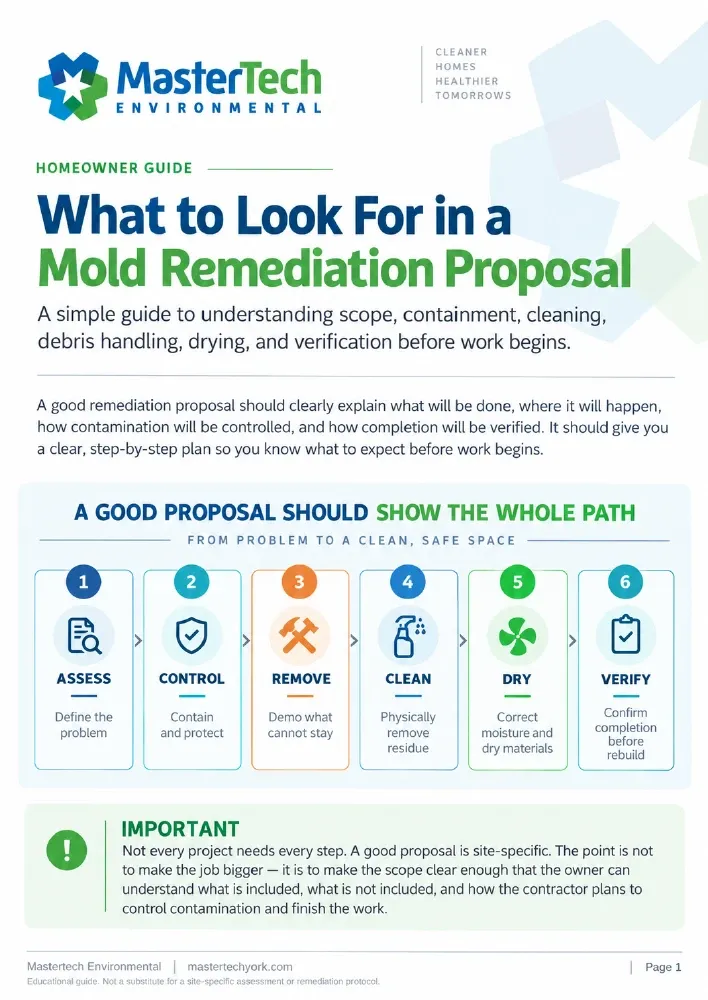
Keep the guide beside you when comparing proposals
Download MasterTech’s illustrated, six-page guide to what a mold remediation proposal should include. It covers scope, containment, debris handling, physical cleaning, drying and verification—with red flags and a homeowner comparison checklist.
6-page PDF · 13.3 MB · Save or print for later
The Mold and Moisture Problem Should Be Clearly Defined
The proposal should identify observed mold, affected materials and the known or suspected moisture source: a leak, seepage, condensation or persistent humidity. Photos, room names and moisture readings help connect the price to an actual problem.
Separate confirmed findings from assumptions about concealed areas. If the cause or extent is unclear, a mold inspection can help establish the scope before bids are compared. Name who will repair the moisture source—and whether that repair is in this contract.
The Remediation Area and Scope Should Be Specific
‘Remediate basement’ leaves too much open. Look for rooms, wall sections, ceiling areas, framing, foundation surfaces and approximate quantities. A sketch or marked photos can define the boundaries.
The proposal should distinguish removal, cleaning and protection of surfaces with settled contamination. State inaccessible areas and exclusions. A clear initial scope can still allow for hidden conditions through a written change-order process.
Contents, Property Protection and Containment
Who moves furniture, boxes and stored belongings? Identify items to protect, clean, evaluate separately or discard—with your authorization. Contents work should not be assumed necessary or included.
Explain protection for floors and unaffected rooms, work-area access and whether occupants must stay out or temporarily relocate. Mold remediation containment may range from localized barriers to full isolation. Its design should reflect the disturbance and exposure risk, not a one-size-fits-all package.
Negative Air, HVAC Protection and Controlled Airflow
The plan should address supplies, returns and openings that could carry contamination beyond the work area. When appropriate, this means isolating affected HVAC openings and coordinating system shutdown rather than allowing the system to distribute work-area dust.
Where negative pressure is warranted, specify HEPA-filtered equipment, a suitable exhaust location and checks that airflow moves toward the contained area—not into clean rooms. An air scrubber recirculating air is not, by itself, negative pressure. HVAC inspection or cleaning is a separate, evidence-based scope, not automatic on every job.
How Workers and Mold-Contaminated Debris Will Leave the Work Area
Ask for the entry, exit and debris route before work starts. The contractor should explain how tools, footwear, protective clothing and waste will avoid carrying dust into occupied areas, and how the travel route will be cleaned.
If debris must pass through clean living space, a temporary contained travel hallway may be appropriate. It is a site-specific option; direct outdoor access or another controlled route may work better. Decontamination arrangements and worker PPE should match the task. Applicable worker-safety requirements remain the contractor’s responsibility.
Demolition Should Be Clearly Defined
Repeated ‘remove as needed’ language is not a measurable demolition plan. Identify materials, locations, approximate quantities and planned limits—for example, an identified wall’s drywall to a specified height, with insulation and trim addressed separately. This is an illustration, not a recommended cut height.
Explain what will remain, how concealed areas will be assessed and when approval is needed to expand removal. Not all mold requires demolition. Before disturbing older materials, address possible asbestos, lead paint, electrical or structural hazards. Pre-1978 painted surfaces may trigger EPA lead-safe renovation requirements; a mold scope does not replace those obligations.
Mold-Contaminated Debris Should Be Properly Bagged and Removed
Debris should be bagged or securely wrapped inside the work area before leaving containment—not carried loose through the house. The plan should explain sealed packaging, large-item wrapping, the exit route and disposal.
EPA guidance recommends double-bagging unsalvageable mold-contaminated materials in 6-mil or thicker polyethylene bags. Include appropriate double-bagging for the project and HEPA vacuuming or damp-cleaning bag exteriors before transport through uncontaminated spaces. Mold debris can generally be construction waste, but asbestos, lead or other regulated hazards may change handling and disposal.
Cleaning Should Remove Mold Contamination — Not Just Treat It
The goal is physical removal of mold and contaminated dust. Spraying, fogging or ‘killing’ mold alone does not accomplish that: dead mold can still cause allergic reactions.
Ask how each salvageable material will be cleaned. Depending on the surface, a sequence may include initial HEPA vacuuming, controlled scrubbing or mechanical cleaning, then another HEPA vacuuming to collect loosened debris. Aggressive abrasion needs suitable dust controls and should not damage the material. The method should fit the surface—not simply the product being sold.
Foundation Walls, Framing and Other Remaining Materials
Removing drywall is only part of the work if mold or contaminated dust remains behind it. Identify exposed foundation walls, studs, joists, subfloor, sill plates, ledges and other affected surfaces to be cleaned.
Masonry and wood may require different techniques. Ask how corners, joints and rough surfaces will be reached, and how damaged materials will be evaluated for replacement. A cleaner-looking wall does not establish that everything behind it was addressed.
Antimicrobials, Stain Removers and Encapsulants
Request product names, intended uses, safety information and any ventilation or re-entry instructions. Avoid promises to make a home permanently ‘mold-proof.’
- Antimicrobials: may be used for a defined purpose, following label directions; they do not replace removal. EPA does not recommend routine biocide use for mold cleanup.
- Stain removers: address appearance. A lighter stain is not proof that contamination has been removed; some discoloration can remain after effective cleaning.
- Encapsulants or coatings: are not a substitute for cleaning or correcting moisture. Ask why a coating is proposed, when it will be applied and how the underlying surface will be inspected first.
Drying and Humidity Control
State who fixes leaks or seepage, what drying equipment is included, and how progress and completion will be documented. Air movers should not spread contamination from uncleaned surfaces into unaffected rooms.
Room humidity is not proof that wood or wall cavities are dry. Agree on material-appropriate moisture checks before rebuilding. For ongoing prevention, EPA recommends indoor relative humidity below 60%, ideally 30–50% where practical. That is general humidity guidance, not a universal clearance reading for every building material.
Final Detailed Cleaning
After removal, surface cleaning and drying, look for a final detailed HEPA cleanup of remaining surfaces and settled dust, with damp cleaning where appropriate. Floors, horizontal ledges, containment surfaces, equipment and access routes can be missed if ‘cleanup’ is left undefined.
The contractor should check that the area is visibly free of mold contamination, dust and debris and explain how barriers will be removed without spreading contamination. Where verification is planned, coordinate barrier removal with that protocol.
Post-Remediation Verification and Clearance
Agree before work starts on who evaluates completion, what will be checked and who pays. Independent post-remediation verification and clearance testing can be useful for larger, complex or disputed projects, or when an agreed protocol calls for it.
Verification should consider the completed scope, visible cleanliness, moisture conditions and relevant odors. Sampling may help answer a defined question, but mold testing is not automatically required and cannot replace inspection. There is no federal numerical ‘safe mold’ threshold.
Hidden Conditions and Change Orders
Opening a wall may reveal more contamination or damage. Ask for a process to document the finding, explain revised work and provide the added price and schedule in a written change order before expanded work is authorized.
A defined allowance or unit price can make changes easier to compare. It should not become permission for unlimited ‘as needed’ work. Clarify the procedure for urgent safety conditions separately.
Reconstruction — Included or Not Included?
Remediation and rebuilding are different scopes. Identify whether new drywall, insulation, trim, paint, flooring or structural repairs are included, excluded or quoted separately.
Name who coordinates moisture repairs, permits where applicable, verification and reconstruction. Remaining materials should meet the agreed drying criteria before closure, and any required project clearance should come first.
Price, Exclusions and Client Responsibilities
Compare equivalent scopes. Ask whether the total includes containment, equipment days, contents handling, disposal, final cleaning, verification and return visits. Document payment stages, estimated dates, insurance, warranties, access, utilities and tasks assigned to you.
For covered Pennsylvania home-improvement work over $500, HICPA requires a written, signed contract with provisions including scope, price, estimated dates and cancellation information. Applicability and exemptions matter. Check required contractor registration; registration is not a technical certification or state endorsement. Use the Pennsylvania Attorney General’s guidance for contract details.
Red Flags in a Mold Remediation Proposal
These are reasons to ask for clarification—not automatic proof that a contractor is doing poor work.
- A one-line ‘spray,’ ‘fog’ or ‘treat’ scope with no physical cleaning.
- Repeated ‘remove as needed’ with no boundaries or change approvals.
- No explanation of moisture correction or protecting unaffected areas.
- Loose debris carried through clean rooms; no controlled exit plan.
- Coating surfaces before their cleanliness and dryness can be checked.
- Rebuilding before agreed verification, or promising zero mold forever.
- Unclear exclusions, open-ended charges or pressure to sign without answers.
Mold Remediation Proposal Checklist
For each proposal, mark what is clearly addressed. ‘Not needed’ is a reasonable answer when the contractor explains why.
- Mold locations, affected materials and moisture source identified
- Work boundaries, quantities and demolition limits defined
- Contents, property protection and appropriate containment explained
- HVAC protection and airflow controls addressed
- Worker route, bagging, bag-exterior cleaning and disposal explained
- Physical cleaning of remaining materials and final HEPA cleanup included
- Product purposes and any coatings distinguished from removal
- Moisture repairs, drying checks and responsibilities assigned
- Completion criteria, any independent PRV and pre-rebuild clearance agreed
- Written changes, reconstruction, exclusions, price and payment terms clear
Why an Independent Mold Inspector Can Help
A remediation contractor performs the cleanup. An independent inspector can help determine the appropriate scope, identify unanswered proposal questions and evaluate the completed work against agreed criteria.
I inspect and test; I do not sell mold remediation. That separation lets me focus on what your home needs without selling you the cleanup. It also supports a useful working relationship with the contractor: a clear plan at the start and a clear definition of completion.
Sources and scope of this guide
Adapted from MasterTech’s homeowner proposal guide and checked against the official resources below. IICRC’s public overview identifies S520:2024; the full paid standard was not reviewed. This guide does not certify a proposal’s compliance or replace a site-specific protocol, professional judgment or applicable legal requirements.
- [1]IICRC — ANSI/IICRC S520:2024 official overview
- [2]EPA — General remediation issues and cleanup methods
- [3]EPA — Containment and personal protective equipment
- [4]OSHA — A Brief Guide to Mold in the Workplace
- [5]EPA — A Brief Guide to Mold, Moisture and Your Home
- [6]EPA — Evaluating the remediation
- [7]Pennsylvania Labor & Industry — Contractor licensing
- [8]EPA — Lead Renovation, Repair and Painting Program
- [9]Pennsylvania Attorney General — Home-improvement contract FAQs