
Indoor Air Quality Testing in York, PA
When one room never feels right, you want to know why. I test the air room by room, compare what I find, and explain it in plain English — added to your mold inspection for one flat price.
- — $165 added to a mold inspection
- — Up to 10 rooms or areas tested
- — Outdoor reference when conditions allow
- — Explained, not just a list of numbers
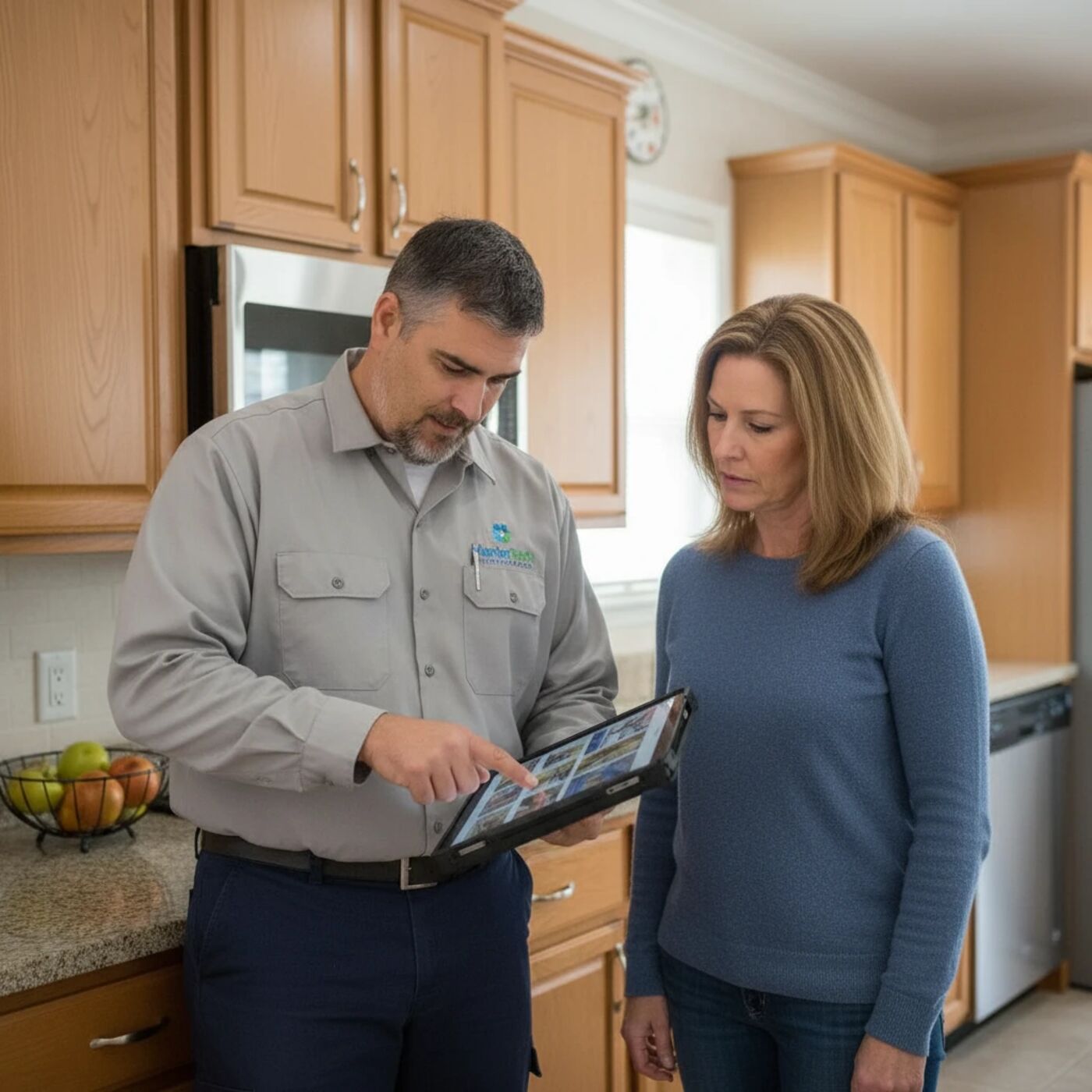
Something about the air in this house isn't right
People who ask me about air quality testing in York, PA usually aren't asking about equipment. They're describing a room.
The basement is where the kids play, and every time you're down there your nose gets stuffy. Or the back bedroom always feels heavy while the rest of the house is fine. Or the dust is back on the TV stand two days after you cleaned.
Those are real things to notice, and none of them is necessarily mold. Air in a house is shaped by dust, pets, cooking, the HVAC, fresh air, dampness and what's coming in from outside. You can't see any of it, so you end up guessing.
One thing up front: air readings can't prove your house is causing anybody's symptoms — that's for your doctor. What I can do is measure the air room by room and show you where the house stands out.
- You feel stuffy in the basement, then fine once you go upstairs
- One bedroom always feels close and heavy
- You dust on Saturday and it's back by Tuesday
- Air that smells musty, stale or just a little off
- Pets, a wood stove or a busy road, and you wonder what that does to the air
- Humidity you can feel, or condensation on the windows
Indoor air quality testing is a $165 add-on to a mold inspection. Tell me what you're noticing and where, and I'll tell you what I'd test.
Room-by-room indoor air testing, added to your mold inspection
$165 on top of a mold inspection and testing visit. Up to 10 rooms or areas, eight readings in each one.
While I'm in the house for the mold inspection, I take a direct-reading measurement in each room or area you want covered — bedrooms, basement, living room, home office, wherever the concern is. When the weather cooperates, I take an outdoor reading too.
That outdoor reference matters: a bedroom running three times higher than the yard is a different story from one matching a smoky summer day. If weather makes it unreliable, I'll say so.
It isn't offered on its own. The readings mean the most when I'm also looking at the moisture, ventilation and HVAC, and that happens on the inspection visit.
Eight readings, up to 10 rooms or areas
- PM1.0 — the finest particles the meter counts
- PM2.5 — fine particles
- PM10 — particles up to about 10 microns
- CO2 — a ventilation indicator
- TVOC — a broad VOC screen
- Formaldehyde (HCHO) — a screening reading
- Relative humidity — moisture in the air
- Temperature — context for everything else
Plus an outdoor reference reading when conditions allow, so every room is compared against the air outside the house.
One reading for the whole house would miss the point
Rooms behave differently, and the differences are where the answers are.
A basement can be damp while the second floor is dry. A bedroom shut all night can be short on fresh air while the living room is fine. One number for the whole house averages all of that away.
So I compare each room against the others and against outdoors. The room that stands out is the one worth talking about, and the way it stands out — fine or coarse particles, high CO2, high humidity, a VOC bump — points toward what's usually behind it.
Here's a made-up example of what that looks like. These aren't readings from a real house.
| Room | PM2.5 | PM10 | CO2 | RH | What stands out |
|---|---|---|---|---|---|
| Outdoors (reference) | 7 | 16 | 420 | 55% | |
| Living room | 6 | 14 | 640 | 47% | |
| Kitchen | 19 | 24 | 780 | 49% | Fine particles up, right after dinner |
| Primary bedroom | 8 | 31 | 1,380 | 52% | CO2 well above outdoors, door closed overnight |
| Finished basement | 11 | 58 | 690 | 67% | Coarse particles and humidity both up |
Illustrative values only. PM in µg/m³, CO2 in ppm. Your report covers all eight readings.
PM1.0, PM2.5 and PM10 testing, in plain English
PM2.5 testing and PM10 testing measure particles sorted by size. Smaller number, smaller particle.
The smallest particles the meter reports, one micron and under. They hang in the air a long time and drift from room to room. When PM1.0 is up, I'm usually thinking about cooking and combustion.
Fine particles, 2.5 microns and under — the number weather apps report for outdoor air. Indoors it rises with cooking, smoke and outdoor air coming in. It includes everything in PM1.0, so the two often move together.
Particles up to approximately 10 microns — which includes the smaller PM2.5 and PM1.0 particles as well as coarser material. When PM10 is substantially higher than PM2.5, that may indicate a stronger contribution from larger airborne particulate: dust, pet debris, pollen, and whatever gets kicked up when you vacuum or the blower starts. Larger particles settle faster, so they're often highest near where they're coming from.
Fine versus coarse: what the pattern can suggest
The useful part is how the sizes compare. When PM1.0 and PM2.5 are up but PM10 isn't much higher, the room is mostly carrying fine particles. Sources consistent with that pattern include cooking, candles, smoke, combustion appliances and outdoor air working its way in.
When PM10 is substantially higher than PM2.5, that may indicate a stronger contribution from larger airborne particulate. Sources consistent with that particle-size pattern include household dust, pet-related debris, pollen, biological particulate, HVAC debris, cleaning activity and construction dust.
Then I put it next to what I know about that room — the humidity, the vents, the dog bed in the corner. That's how a pattern becomes something you can act on.
What I look at when particles stand out
What particle testing can't do
A particle meter sorts particles by size. It does not identify what a particle is, and it cannot prove particles are mold, dust, dander or pollen. What I'll tell you is which sources are consistent with the particle-size pattern, and whether mold testing in that area is worth doing to find out.
CO2, VOCs, formaldehyde, humidity and temperature
These five readings fill in why a room feels the way it does.
CO2 — a ventilation indicator
People breathe out CO2, so it builds up in occupied rooms that don't get much fresh air. I treat it as a ventilation indicator, not a health limit or a pass/fail number, and read it relative to the outdoor reading (usually in the low 400s ppm), how many people were in the room, and conditions like a closed door or a running system. A closed bedroom that climbs well above outdoor levels overnight while the rest of the house doesn't suggests that room isn't getting much air exchange — so anything else in it may be lingering too.
TVOC — a broad VOC screen
One number covering a whole family of chemicals from paints, cleaners, air fresheners, new furniture, flooring and stored products. It won't tell you which chemical is present. It tells you whether one room is noticeably higher than the rest, which is usually enough to start looking.
Formaldehyde (HCHO) screening
Formaldehyde can come from pressed-wood products, some cabinetry and furniture, new flooring and combustion. The screening reading spots a room that stands out. If one does, I'll tell you whether confirmatory lab testing is worth paying for.
Relative humidity
This one ties straight back to mold. I like to see most of a house between about 30 and 50 percent. A room holding above 60 for long stretches is where mold and dust mites get comfortable — and York County basements run high all summer.
Temperature
Context for everything else. Humidity depends on temperature, VOCs come off materials faster when it's warm, and a room much colder or warmer than the rest often has an air-flow story behind it.
Ready to see your own rooms side by side?
$165 for up to 10 rooms or areas, added to your mold inspection.
What indoor air testing does and doesn't tell you
I'd rather you know the limits before you pay for it than find out after.
What it tells you
- Which rooms stand out from the rest of the house and outdoors
- Whether a room's particles lean fine or coarse
- Which household sources are consistent with that pattern
- Which rooms look under-ventilated, based on CO2
- Whether VOC or formaldehyde screening is higher anywhere
- Where humidity matters for mold and moisture
What it doesn't
- What a particle is — it can't prove particles are mold, dust, dander or pollen
- Which specific chemicals make up a TVOC reading
- A lab-grade formaldehyde concentration
- Whether the house caused anyone's symptoms
- Whether there's hidden mold behind a wall — that's the mold inspection's job
- What the air is like every hour — it's a snapshot of the visit
How it works with your mold inspection and mold testing
Mold sampling and air quality screening answer different questions.
The mold inspection is the main event: moisture readings, thermal imaging, and lab samples where they'll answer something. Mold testing in York, PA is targeted on purpose — the 4 included samples go where the evidence points, not one in every room.
That's where air quality screening earns its keep. Mold samples go deep in selected areas; the IAQ readings give the broad, room-by-room picture. A room with unusual readings may justify a closer look during the inspection, but where mold samples go is still based on moisture findings, visible conditions, odors, the history of the space and other supporting evidence. And if the mold results come back normal, the air readings may provide additional clues about ventilation, particulate, humidity or other indoor conditions in that stuffy bedroom.
Both sets of findings go into one conversation and one plan.
Mold sampling vs. IAQ screening
Lab analysis in selected areas. Identifies mold types. Deep, but only where samples are taken.
Eight direct readings in up to 10 rooms or areas. Broad, but doesn't identify what particles are.
What I might recommend
You only get the ones that apply to your house.
Source control
Find what's putting particles or VOCs into a room and deal with it. Usually the cheapest fix.
Better cleaning
HEPA vacuuming and damp dusting where dust collects and gets stirred back up.
HVAC filtration
A better filter that fits the slot, changed on schedule, and servicing if needed.
Moisture correction
Fix the water — grading, gutters, leaks — so the humidity doesn't come back.
Additional mold sampling
More sampling where moisture findings, visible conditions, odors or history point toward mold.
Confirmatory or specialty testing
Lab VOC or formaldehyde testing when a screening number justifies it.
I don't sell purifiers, duct cleaning, dehumidifiers or remediation, and I don't take referral fees. A recommendation from me is just a recommendation.
You get more than a page of numbers
The value is in what someone does with the numbers.
I don't just give you numbers. I compare the rooms, explain what stands out, tell you which common household sources are consistent with the patterns, and give you practical recommendations, cheapest first. Sometimes the answer is just cracking the bedroom door at night. Either way, you stop guessing.
- Rooms compared side by side, plus outdoors
- What stands out, in plain English
- Sources consistent with each pattern
- Practical recommendations
Indoor air quality testing cost
Flat pricing. You know the number before I show up.
Indoor air quality testing added to a mold inspection and testing visit.
- Up to 10 rooms or areas
- PM1.0, PM2.5, PM10, CO2, TVOC, HCHO, RH and temperature
- Outdoor reference when conditions allow
- Rooms compared and explained, with recommendations
More than 10 rooms or areas? You'll have a price before anything is scheduled.
(717) 676-3574Only offered with a mold inspection, which is $450 residential with 4 lab samples included.
Full inspection pricingWhere air quality testing fits
It's one piece of a full look at the house.
Mold inspection and testing
The inspection this add-on rides with — visual, moisture readings, thermal imaging and 4 accredited lab samples for $450.
Learn moreMold testing in York, PA
Air, surface and ERMI sampling — what each test answers.
Learn moreMoisture intrusion inspection
When humidity points at water getting in, this finds the source.
Learn moreBasement mold inspection
Where humidity, dust and weak ventilation most often stack up in York County homes.
Learn moreCrawl space mold inspection
Damp crawl space air rises into the rooms above. This is where to check first.
Learn moreAttic mold inspection
Heat, humidity and venting problems that can show up in the bedrooms below.
Learn moreMore on indoor air in York County homes
Written up from real inspections — humidity, allergens, ventilation and what's worth worrying about.
Mold, Allergies, and Indoor Air Quality: What's the Connection?
If someone in your household has unexplained allergy symptoms, chronic respiratory issues, or headaches that improve when they leave home, mold may be compromising your indoor air quality. This guide explains exactly how mold affects the air you breathe.
Read the articleSummer Humidity & Indoor Air Quality in PA Homes
Pennsylvania summers bring high humidity, warm temperatures, and conditions that are nearly ideal for mold growth. Understanding how summer humidity affects your home's indoor air quality is the first step to protecting your family's health.
Read the articleHow Indoor Air Quality Affects Sleep in York, PA Homes
Restless nights are not always caused by stress or a bad mattress. Humidity, allergens, mold, ventilation, and hidden moisture can all make a York County bedroom less comfortable—and leave clues worth investigating.
Read the articleWhat people say after an inspection
Rated 5.0 from 5 Google reviews.
I could not recommend this business enough for mold inspections! If you're looking for quick turnaround, great communication and honest upfront service - this is your place. Tom was respectful, professional, and explained everything in great detail.
Truly the best! I can't say enough good things about Tom. I truly feel like I had someone I could count on by my side during this very stressful situation.
We had a great experience with Tom at Mastertech throughout this whole process. They took extra time to answer all of our questions and explained everything in a way that actually made sense.
Indoor air quality testing questions
No. It's only offered as a $165 add-on to a mold inspection and testing visit, covering up to 10 rooms or areas. The readings mean more when I'm also checking the house for moisture, ventilation and mold.
Where I work
I cover York and the towns around it — basically anything within about 7 miles of 2400 Taxville Rd, York, PA 17408, plus a good bit of York County beyond that. If you're close and don't see your town, call me anyway.
Based in York, not a call center
You reach me directly, and I'm the one who shows up and does the inspection. Most weeks I can be out within a couple of days, sooner if you're up against a closing date.