
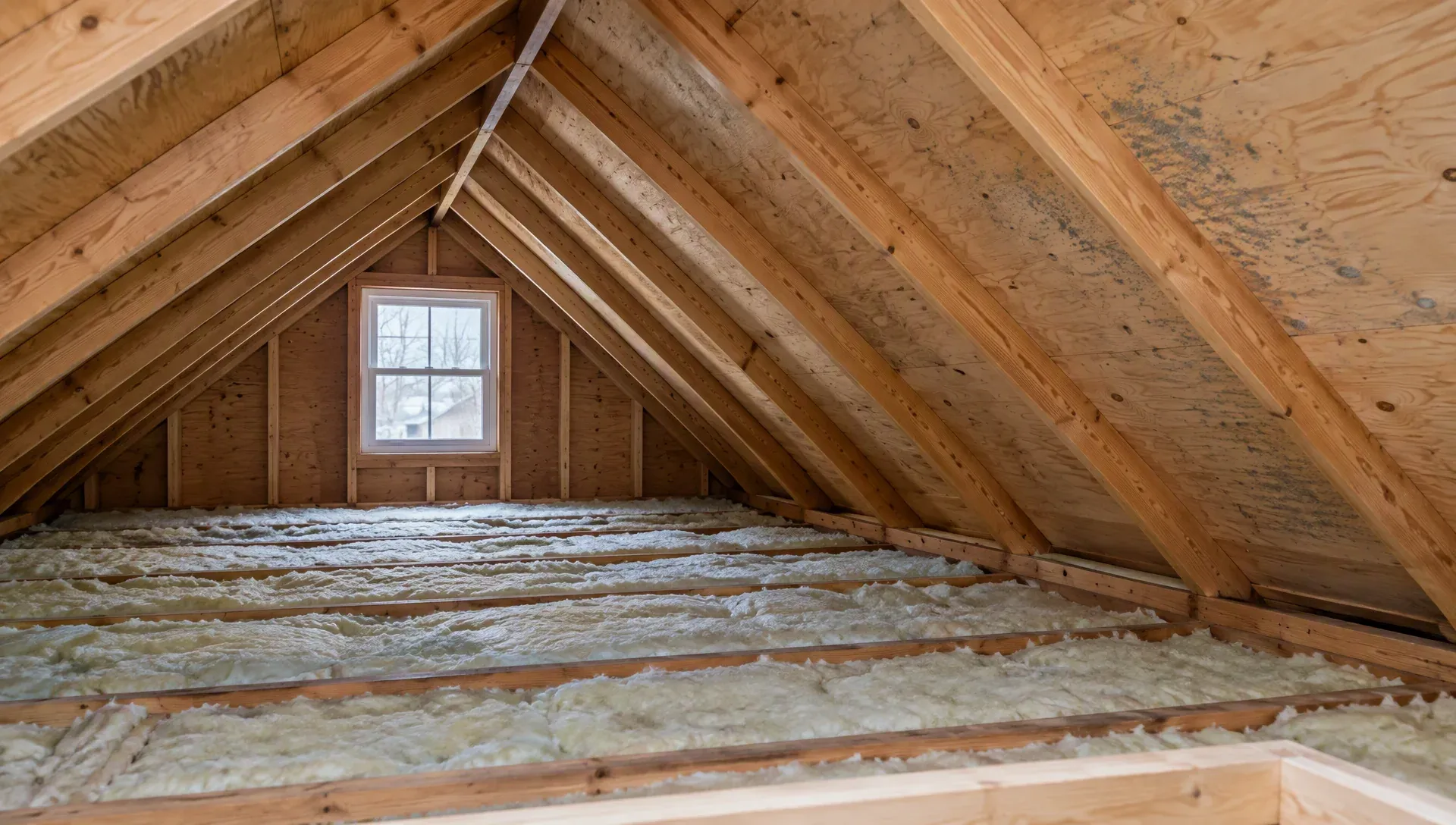
Roof leaks are only part of the story. Learn how condensation, exhaust ducts and air leakage can lead to attic mold — and what to check before paying for cleanup.
An attic can develop mold even when the rooms below look dry and the roof is not leaking. Warm indoor air, a disconnected bathroom exhaust duct, or blocked ventilation can leave roof sheathing damp enough for growth. The useful question is not just “Is that mold?” It is “Why is this wood getting wet, and what needs to change?”
For York homeowners, the sensible approach is to document the condition, identify the moisture source, and decide whether cleanup and repairs need professional help. A dark patch does not automatically mean a roof replacement. A clean-looking attic does not rule out a moisture problem either. This guide explains what to watch for, what an inspection should address, and how to reduce the chance of a repeat problem.
Why York-area attics can develop moisture problems
York County has hot, humid summers and moderately cold winters, as Explore York’s weather overview describes. That seasonal contrast matters because an attic’s temperature and drying conditions change throughout the year. It does not establish how common attic mold is locally, and weather alone does not explain an individual home’s problem.
In winter, moisture carried by indoor air can reach cold roof sheathing. If a surface is cold enough for that air’s moisture to condense, water collects on the wood or roofing nails. Frost may form during cold conditions and melt when temperatures rise. The Building America condensation guide identifies limiting air leakage and reducing indoor humidity as important controls.
During warmer weather, a roof leak or poorly routed exhaust can still wet attic materials. A hot attic is not proof that every concealed surface is dry. The building’s actual roof, insulation, air barrier, and ventilation arrangement matter more than a general claim that Pennsylvania weather causes mold.
Most of the guidance below concerns an unfinished, vented attic, with insulation at the attic floor. A finished attic or deliberately unvented roof assembly needs a different assessment, as the Building America guide to vented and unvented attics explains. Do not add vents to a sealed, spray-foam-insulated assembly without checking its design with a qualified building professional.
Four moisture sources worth checking first
1. Roof leaks and flashing problems
Water can enter around damaged roofing, chimneys, valleys, plumbing vents, and other roof penetrations. The U.S. Department of Energy’s Guide to Durable Attics lists roof leaks, flashing defects, and ice dams among possible moisture sources.
A concentrated stain near a penetration, wet insulation beneath it, or a change after rain points toward a leak worth investigating. Those clues are not a diagnosis: water can travel along framing before appearing somewhere else. Have a roofing professional trace the source rather than replacing shingles based only on where an interior stain appears.
If this pattern fits your home, the article on roof leaks and attic mold in York explains that connection in more detail.
2. Bathroom or other exhaust ending inside the attic
A bathroom fan should carry humid air outdoors, not simply move it out of the bathroom. A duct that stops inside the attic, has separated from its connection, or leaks along its route can deposit moisture near the roof deck. Kitchen and dryer exhaust also should not discharge into the attic.
DOE specifically warns against venting these moisture sources into attic space. Hearing a fan run is not evidence that its duct reaches the exterior. Ask a qualified contractor to check the full route, connections, and termination, including whether exhausted air can be drawn back through nearby intake vents.
3. Indoor air leaking through the attic floor
Gaps around the attic hatch, wiring, plumbing, ceiling penetrations, and wall openings can allow warm indoor air into the attic. Insulation slows heat transfer; it does not automatically make those openings airtight. Adding insulation over an unsealed opening may leave the moisture pathway in place.
Air sealing belongs in the repair conversation, but not every gap can safely be filled with ordinary spray foam. Chimneys, flues, electrical fixtures, and other components have clearance and material requirements. A qualified home-performance or insulation contractor should address those details without creating a fire or combustion-safety problem.
4. Obstructed or poorly coordinated attic ventilation
In a conventional vented attic, intake and exhaust openings need a usable airflow path. Insulation pushed into the eaves can block soffit vents. Baffles help keep those paths open. ENERGY STAR’s attic ventilation guidance emphasizes air sealing, insulation, and keeping soffit vents clear.
Ventilation is part of the system, not a substitute for fixing a roof leak or bathroom duct. Installing a powered attic fan is not an automatic cure. ENERGY STAR warns that a fan can pull conditioned air from the house when the attic is poorly sealed and intake vents are blocked. Have the existing assembly assessed before buying more ventilation equipment.
Warning signs: what matters more than color
Possible warning signs include:
- Patchy or speckled discoloration on roof sheathing or framing.
- Damp, compressed, or water-stained insulation.
- Water droplets, frost, or moisture staining around roofing nails.
- A musty odor at the attic opening or in nearby rooms.
- Stains that change after rain or return during cold weather.
- Soft, deteriorated, or visibly damaged wood requiring a contractor’s assessment.
Not every dark mark is mold. Water staining, dirt, and other discoloration can look similar in a photograph. Conversely, the absence of an odor does not prove that the roof assembly is dry. A useful assessment combines the visible condition with moisture measurements, building details, and the timing of the problem.
Black or dark growth is not a reliable way to identify a species or determine health risk. CDC/NIOSH explains that mold color does not necessarily indicate whether it is more or less dangerous. Ask what evidence supports the diagnosis, not whether the patch looks alarming.
What you can do safely before an inspection
Start with information, not disturbance. If the opening is safely accessible, take photographs from that location and record when you noticed the condition. Note recent roof work, insulation upgrades, bathroom renovations, storm damage, or exhaust-fan changes. Those details help establish what should be checked.
Do not walk on exposed ceiling drywall or assume insulation hides a safe walking surface. Avoid entering an attic with questionable access, exposed wiring, damaged framing, extreme heat, or unfamiliar insulation. If you suspect vermiculite insulation, EPA advises leaving it undisturbed. Obtain appropriate professional guidance before attic work.
Do not brush, sand, or scrape suspected growth to “see what is underneath.” Avoid opening concealed assemblies yourself. Where safe, protect the rooms below from an active leak while arranging repair. If water has affected materials, act promptly: EPA recommends drying wet areas within 24–48 hours to help prevent growth. That is a prevention window, not a guarantee that an older problem is harmless.
What a useful attic mold inspection should answer
An inspection should do more than confirm that a suspicious patch exists. It should connect the visible condition to a plausible moisture source and clearly state what could not be accessed or verified. Useful questions include:
- Where is the suspected growth, and how extensive is the accessible affected area?
- Are the materials wet now, or is there evidence of an earlier moisture event?
- Does the pattern suggest leakage, condensation, an exhaust problem, or several contributors?
- Are attic access points, ceiling penetrations, ducts, and ventilation paths relevant?
- Is there visible deterioration that needs a roofer or structural professional?
- Would sampling answer a specific unresolved question, or would it add little?
One dry reading does not explain an intermittent leak. Likewise, visible staining alone does not establish when growth occurred. The report should distinguish observations from conclusions and recommend the appropriate next specialist where necessary.
For attic mold inspection in York, PA, my role is inspection and testing, not selling remediation. Separating those roles helps keep the findings and repair recommendations distinct from a cleanup estimate.
Do you need mold testing?
Not automatically. EPA states that sampling is usually unnecessary when visible mold growth is present. CDC/NIOSH also does not recommend routine air sampling for building air-quality evaluations and notes that thorough visual inspections and musty odors can be more reliable for identifying dampness problems.
Sampling may be useful when there is a defined question, such as whether an ambiguous surface deposit is fungal growth. Before paying, ask what the proposed sample will establish and how its result would change the next step. No sample replaces investigation of the moisture source.
There are no federal health-based indoor mold-spore limits that turn a number into a universal safe-or-unsafe verdict. A brief air sample also cannot certify that concealed materials are free of mold. Treat laboratory results as one piece of a building assessment, not a medical diagnosis or a guarantee about every room.
Cleanup: small patch or professional project?
EPA says homeowners can often handle mold affecting less than about 10 square feet, following its cleanup guidance. That is a general guideline, not a legal threshold or a promise that a small attic patch is an easy DIY job. Restricted access, exposed wiring, porous materials, extensive water damage, and occupant health concerns can change the decision.
For growth spread across multiple roof panels, difficult access, damaged materials, or an unclear scope, seek a qualified remediation contractor. Ask how the work area will be managed, how debris will be removed without spreading it, which materials will be cleaned or replaced, and how completion will be checked.
Avoid accepting “spray it and forget it” as the entire plan. EPA does not recommend bleach or other biocides as a routine mold-cleanup practice. Killing growth is not the same as removing affected material and correcting moisture. Painting over a moldy surface before cleaning and drying it is not a repair.
If you are comparing bids, use the homeowner guide to mold remediation proposals. It helps separate a documented work plan from a vague treatment promise.
Does attic mold mean replacing the roof?
Not necessarily. Surface growth and structural deterioration are different findings. Some projects involve cleaning sound wood and correcting moisture; others involve replacing damaged sheathing, insulation, or roofing components. A photograph or the color of a stain cannot determine which approach is appropriate.
Ask the contractor to explain why any proposed replacement is necessary and which materials are affected. If wood appears soft, deteriorated, or structurally compromised, obtain the appropriate building professional’s assessment. The cleanup scope and roof-repair scope should agree on the moisture cause, rather than leaving each contractor to assume the other is handling it.
Preventing a repeat problem
The most effective prevention plan addresses the source identified in your house:
- Repair roof and flashing defects, then verify that affected materials have dried.
- Route bathroom and other exhaust outdoors with sound connections and appropriate terminations.
- Air-seal the attic boundary safely before adding insulation over accessible leakage paths.
- Keep intended ventilation paths open in a vented attic; do not retrofit vents into an unvented assembly without design guidance.
- Manage moisture in the living space with working exhaust and appropriate humidity control.
- Recheck repaired areas after relevant weather conditions, not just on the day work ends.
EPA recommends indoor relative humidity below 60 percent, ideally 30–50 percent where possible. That guidance concerns occupied indoor space. It is not a fixed year-round humidity target for an outdoor-vented attic, and cold weather may require lower indoor humidity to avoid condensation on cold surfaces.
Keep photographs and repair records. After a roof replacement or insulation project, ask whether exhaust routing, ceiling air sealing, and ventilation paths were checked. Do not assume that new shingles or deeper insulation automatically resolve an existing attic moisture problem.
Common questions from homeowners
Can attic mold affect the rooms below?
An attic finding alone does not show the degree of exposure in occupied rooms. Air pathways, disturbance, and the extent of dampness matter. CDC notes that mold exposure can cause symptoms in some people, including people with allergies or asthma, while others may have none. Discuss persistent symptoms with a healthcare professional rather than trying to diagnose their cause from an attic photo.
Can a dry attic still have old mold staining?
Yes, visible marks may remain after a moisture event, but appearance alone cannot establish whether a problem is resolved. Look for evidence that the source was repaired, materials dried, and appropriate cleanup completed. A dry inspection day is useful information; it is not proof that the attic stays dry during rain or winter conditions.
Should I wait until I sell the house?
No reason to postpone investigating an active moisture source. Addressing it now gives you time to compare recommendations and document the repair. If you are buying, ask what was found, what work was completed, and what remains uncertain. Do not treat a fresh coating or a verbal assurance as the entire history.
The next step for your York home
If you notice staining, moisture, or an exhaust problem, document it safely and investigate the cause before approving a cleanup package. Clear findings should lead to specific repairs, a defined cleanup scope where needed, and a practical follow-up check.
If you need help deciding whether an assessment makes sense, contact MasterTech Environmental of York and describe what you have noticed. I inspect and test; I do not sell remediation. The goal is to understand the condition well enough to choose the next step without buying work you do not need.
Sources and further reading
This article draws on the public guidance below, reviewed October 13, 2026. These sources explain general building and mold principles; they do not establish local mold prevalence or diagnose a particular York home.
- U.S. EPA: A Brief Guide to Mold, Moisture and Your Home — moisture control, cleanup, humidity and sampling.
- U.S. Department of Energy: Guide to Durable Attics — roof leaks, exhaust, air sealing and ventilation; published October 2010.
- PNNL Building America Solution Center: Condensation Control in Attics and Roofs in Cold Weather — cold-weather moisture controls.
- ENERGY STAR: About Attic Ventilation — insulation baffles, ventilation and powered-fan cautions.
- CDC/NIOSH: Mold, Testing, and Remediation — limitations of color identification and routine air sampling.
- CDC: Mold — health considerations.
- Explore York: York County Weather — local seasonal context only.
- PNNL: Vented versus Unvented Attic — different roof-assembly approaches.
- U.S. EPA: Asbestos-Contaminated Vermiculite Insulation — precautions before disturbing insulation.