
Water Damage Inspections in York, PA
An independent inspection before or after the restoration crew. I document what the water actually reached, verify the drying is genuinely finished, and confirm whether mold has taken hold.
- — 17+ years, 8,000+ inspections
- — Calibrated moisture meters and thermal imaging
- — No restoration or drying sold, ever
- — Report in 1-2 business days
A second opinion, before or after the restoration
The restoration company's job is to dry and rebuild. Nobody on that job is being paid to tell you when to stop.
When water gets into a building — a flood, a burst pipe, a roof that let go in a storm, a washer hose that failed while you were at work — the people who show up are there to dry it and put it back. Most of them are competent and most of them are honest. But they define the scope of work they are paid for, and surface drying is not the same thing as structural drying.
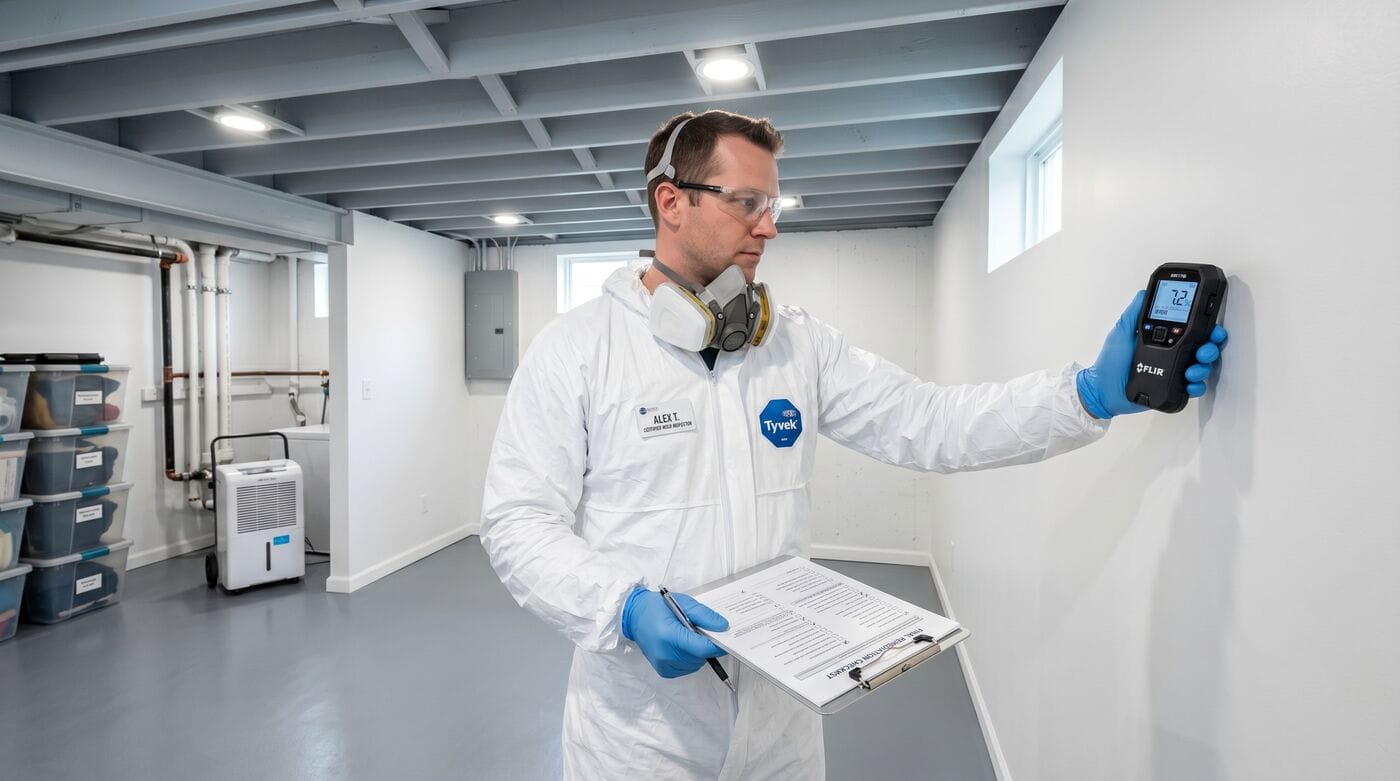
A water damage inspection is an independent read on what actually happened to your building. I document the full extent of what the water reached, take moisture content readings off walls, floors and framing by location, run thermal imaging to find the migration you cannot see, and assess whether mold has started or is about to.
There are two moments where that is worth paying for. Before the restoration work begins, to establish an objective baseline and check the proposed scope against the actual damage. And after the crew says the job is done, to verify the materials are genuinely back to normal moisture content instead of just dry to the touch. Both produce documented third-party evidence — which is what matters when a claim gets disputed, when a contractor and an owner disagree, or when you have to disclose something at a sale.
I do not sell drying, demolition, restoration or waterproofing, and I take no referral fees from anyone who does. That is the entire value of the inspection: there is no finding I could write that pays me more than any other.
Before the restoration, or after it
Which one you want depends entirely on where you are in the process. They answer different questions.
Pre-drying inspection
When the restoration company arrives, the clock starts and the evidence starts disappearing. Material gets cut out, carpet goes in a dumpster, and the conditions your claim depends on stop existing. A pre-drying inspection documents the full extent of the damage before any of that happens, which protects you through both the claim and the contractor relationship.
- Independent documentation of every affected area before anyone starts cutting
- Moisture readings in walls, floors, ceilings and structural framing
- Water migration paths, including the rooms nobody thought were involved
- An objective baseline for the insurance claim while conditions still exist
- A check on whether the proposed restoration scope matches the actual damage
Clearance inspection
The equipment is gone and the invoice has arrived. So how do you know it is dry? Surface dry is not structural dry — moisture persists inside wall cavities, under flooring and in framing for weeks after the dehumidifiers leave, and mold grows in those spaces with nothing showing on the surface. A clearance inspection settles it with readings.
- Verification that every previously affected area is back to normal moisture content
- Meter readings by location, compared against dry material in the same building
- Mold assessment, and lab sampling where growth or odor justifies it
- Documentation you can file with a claim or attach to a sale disclosure
- Confirmation the problem is actually finished instead of covered up
Not sure which one applies to you? Call or text (717) 676-3574 and describe what happened. If neither is worth the money in your situation, I will say that too.
Water events worth an independent inspection
Any significant water event can leave moisture behind where nobody is looking. These are the ones I get called out for most.
Basement flooding
Groundwater, a sump pump that failed during a storm, or a floor drain that backed up. The visible water leaves in an afternoon; the moisture in the block, the framing, the insulation and the drywall bottom stays for weeks, which is the part that grows things.
Burst or leaking pipes
A burst supply line or a slow fitting leak inside a wall wets the cavity, the subfloor and the room on the other side before anybody notices. By the time there is something to see, the wet area is almost always larger than the stain.
Roof leaks and storm damage
Roof water runs along rafters, soaks insulation and sits in a ceiling assembly before it shows up on your drywall. The mark on the ceiling is rarely under the entry point and almost never the full extent of what got wet.
HVAC and appliance failures
A blocked condensate drain, an overflowing pan above a finished ceiling, a water heater that let go in a utility closet, a washer supply hose. These run quietly and they run into subfloors and wall bases where nobody is looking.
Sewage backups
Both a moisture problem and a contamination problem. I document the full extent of the affected area and whether residual moisture remains after the cleanup, which matters for what has to be removed rather than dried.
Commercial water events
Offices, retail, restaurants and multi-unit buildings, where the water crosses tenant lines and the documentation has to hold up for a commercial claim file and a property manager at the same time.
What happens during a water damage inspection
Same sequence whether it is a finished basement in Dallastown or a flooded retail unit in Springettsbury.
Full visual assessment
Every accessible area — not just the room with the obvious problem. Staining, discoloration, swelling, warping, peeling paint, efflorescence, delaminating flooring, tide lines on block. Water travels, so the walk covers where it could have gone.
Moisture meter readings
Calibrated pin and pinless meters on drywall, framing, subfloor, masonry and flooring, logged by location so the report is a moisture map rather than a paragraph. Control readings off unaffected material in the same building give the numbers meaning.
Thermal imaging scan
Infrared to find moisture behind finished surfaces without opening them. Every anomaly gets confirmed with a meter before it counts as a finding — infrared shows temperature, and temperature has more than one cause.
Mold assessment
Water damage creates mold conditions inside 24 to 72 hours. I check the affected areas for visible growth and musty odor, and where it is justified I take air or surface samples for accredited independent lab analysis.
Scope verification
On a pre-drying inspection, I compare what I found wet against the restoration contractor's proposed scope of work. That comparison is often the single most valuable page in the report — it catches the cavity nobody planned to open.
Written report
Readings by location, thermal images paired with photos, lab results where applicable, a plain-English summary, recommendations and limitations. Formatted so an adjuster, an attorney, an agent or a contractor can all use it. In your hands in 1-2 business days.
Why hire someone with no stake in the repair
An independent inspection is only worth what the inspector's independence is worth.
Nothing to sell you
Restoration companies are paid for the work they scope. That is not a conspiracy, it is just how the incentive runs — and it means nobody on the job is being paid to say the building is dry and the billing should stop. I do not sell drying, demolition, restoration, waterproofing or remediation.
Third-party documentation
Moisture readings, dated photographs and thermal images from someone with no stake in the outcome are a different kind of evidence than a contractor's own paperwork. Claims, disputes, disclosures and litigation all turn on that distinction.
Mold expertise, not just meters
The real question after a water event is whether conditions existed long enough for mold to establish, and where. That takes someone who knows the biology and the timelines, not just someone who can read a number off a display.
Fast scheduling
Water damage work is time-sensitive in both directions — before the crew starts and before they close out the job. I schedule quickly and the report follows in 1-2 business days.
Instruments that belong on a job
Calibrated pin and pinless meters, a thermo-hygrometer, a professional infrared camera, and an accredited independent lab for any samples. Consumer-grade tools produce numbers that fall apart the moment anyone questions them.
17+ years of it
8,000+ inspections across York County. I know where residual moisture hides after a dry-out, because I have been finding it in the same handful of places for seventeen years.
Who books a water damage inspection
Any owner, buyer or manager dealing with a water event, current or historical.
Filing a claim? Get your own documentation first.
The adjuster works for the insurance company. That is not a criticism — it is the job description. Their assessment is the insurer's assessment of the claim, and it is the only assessment in the file unless you put one there yourself.
An independent inspection report with moisture readings by location, dated photographs and thermal images gives you your own record of conditions as they actually were. That record matters most in three situations: when the scope of damage is disputed, when a claim comes back underpaid against what the repair costs, and when you have to demonstrate that secondary damage like mold followed directly from the original water event rather than being a pre-existing condition.
To be clear about what I am not: I do not negotiate claims, I am not a public adjuster, and I do not tell you what your settlement should be. I document the building accurately and you or your representative use that document.
What goes in the file
- Moisture content readings listed by room and material
- Relative humidity by area at the time of inspection
- Thermal images paired with matching visible-light photos
- Accredited independent lab results where samples were taken
- Scope-ready recommendations a contractor can bid from
- A limitations section stating what could not be accessed
Indoor Air Quality Testing After Water Damage
After a leak or flood, drying equipment, tear-out and repairs all change the air. Humidity, construction dust and particulate can stay up in the affected rooms. Comparing them with unaffected rooms and outdoors shows what stands out, adding clues beyond mold sampling alone. If drying is still going on, read why dehumidifiers help, and when they don't.
- PM1.0
- PM2.5
- PM10
- CO2
- TVOC
- Formaldehyde screening
- Relative humidity
- Temperature
Particle readings point to common household sources consistent with the particle-size pattern observed. They don't identify a particle as mold, dust, pollen or pet dander.
Learn More About Indoor Air Quality TestingWhat a mold inspection costs in York, PA
Flat pricing, nothing hidden. Extra samples beyond the 4 included are $85 each. Lab results come back in 1-2 business days.
- Visual inspection of the areas of concern
- Thermal imaging
- Moisture meter readings
- 4 air or surface samples
- Accredited independent lab analysis
- Written report with photos and readings
- Phone walkthrough of the results
Covers properties or inspected areas up to approximately 2,500 sq ft. Larger properties may need more inspection time, more areas or more sampling, so the price can go up — I'll tell you the number before I come out.
Schedule a residential inspection- Visual inspection of the areas of concern
- Thermal imaging
- Moisture meter readings
- 4 air or surface samples
- Accredited independent lab analysis
- Written report with photos and readings
- Phone walkthrough of the results
Covers the extra reporting and square footage that comes with commercial buildings. Additional samples $85 each.
Schedule a commercial inspectionSee the report before you hire me
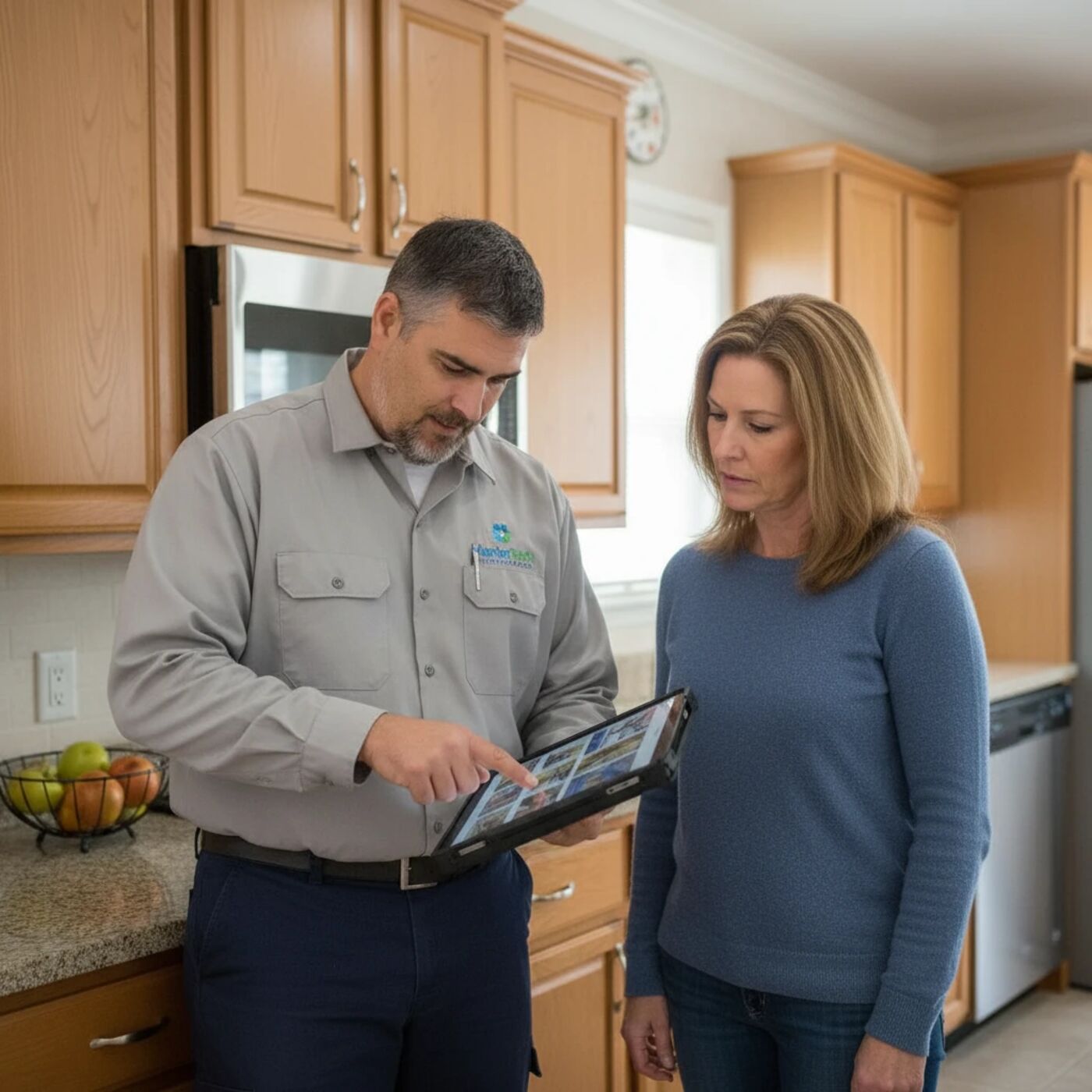
The inspection is only worth as much as the paperwork you're left holding. Mine lays out what I looked at, what I found, what the lab said, and what should happen next — in language you can hand to a contractor, a landlord, or a realtor.
- Inspection summary
- Lab sample results
- Moisture readings
- Area-by-area notes
- Photos of findings
- Recommendations
- Limitations
- Next steps
Where water damage work fits with the rest of it
Water damage inspection is one piece of a full mold and moisture assessment.
Moisture intrusion inspection
Where water is entering or accumulating, measured with meters, humidity readings and thermal imaging — and traced back to the source.
Learn morePost-remediation verification
Independent clearance testing after mold remediation, with accredited lab analysis and documentation the contractor cannot write for themselves.
Learn moreMold inspection and testing
Full residential and commercial mold inspection with accredited independent lab analysis and a written report in 1-2 business days.
Learn moreLooking for something more specific?
If you landed here searching for one particular thing, these go straight at it.
Mold inspection cost in York, PA
The flat price — $450 residential, $785 commercial — what it includes, and why free inspections cost more.
Read thisMold inspector near me
What a real inspection covers, what to ask before you hire, and why free ones cost more.
Read thisMold testing near me
Air, surface and ERMI testing explained, with what each one can and can't tell you.
Read thisAttic mold
Why attics in this climate grow mold on the sheathing, and how the testing answers it.
Read thisArticles on water, drying and what comes after
Written up from actual inspections around York County.
Basement Mold in York, PA: What You Need to Know
York, PA — Basement Mold Resource
Read the articleFall Drainage Issues & Foundation Moisture
Fall is when drainage problems become mold problems. Clogged gutters, saturated soil, and heavy autumn rains drive moisture into basements and crawl spaces just as temperatures create ideal mold growth conditions. Here's what to do before winter arrives.
Read the articleSpring Snow Melt & Basement Moisture in York County
Every spring, York County homeowners face the same risk: rapid snowmelt saturates the soil, overwhelms drainage systems, and drives moisture into basements and crawl spaces. Here's what to watch for and exactly how to protect your home before mold takes hold.
Read the articleWhat people say after an inspection
Rated 5.0 from 5 Google reviews.
I could not recommend this business enough for mold inspections! If you're looking for quick turnaround, great communication and honest upfront service - this is your place. Tom was respectful, professional, and explained everything in great detail.
Truly the best! I can't say enough good things about Tom. I truly feel like I had someone I could count on by my side during this very stressful situation.
We had a great experience with Tom at Mastertech throughout this whole process. They took extra time to answer all of our questions and explained everything in a way that actually made sense.
Water damage inspection questions
An independent assessment of what a water event actually did to your building. I document every area that shows water contact, take moisture content readings by location, run thermal imaging to find migration behind finished surfaces, and assess whether mold has started. It comes in two flavors: before restoration begins, to establish a baseline and check the proposed scope, or after the restoration company says it's done, to verify the place is actually dry.
Where I work
I cover York and the towns around it — basically anything within about 7 miles of 2400 Taxville Rd, York, PA 17408, plus a good bit of York County beyond that. If you're close and don't see your town, call me anyway.
Based in York, not a call center
You reach me directly, and I'm the one who shows up and does the inspection. Most weeks I can be out within a couple of days, sooner if you're up against a closing date.